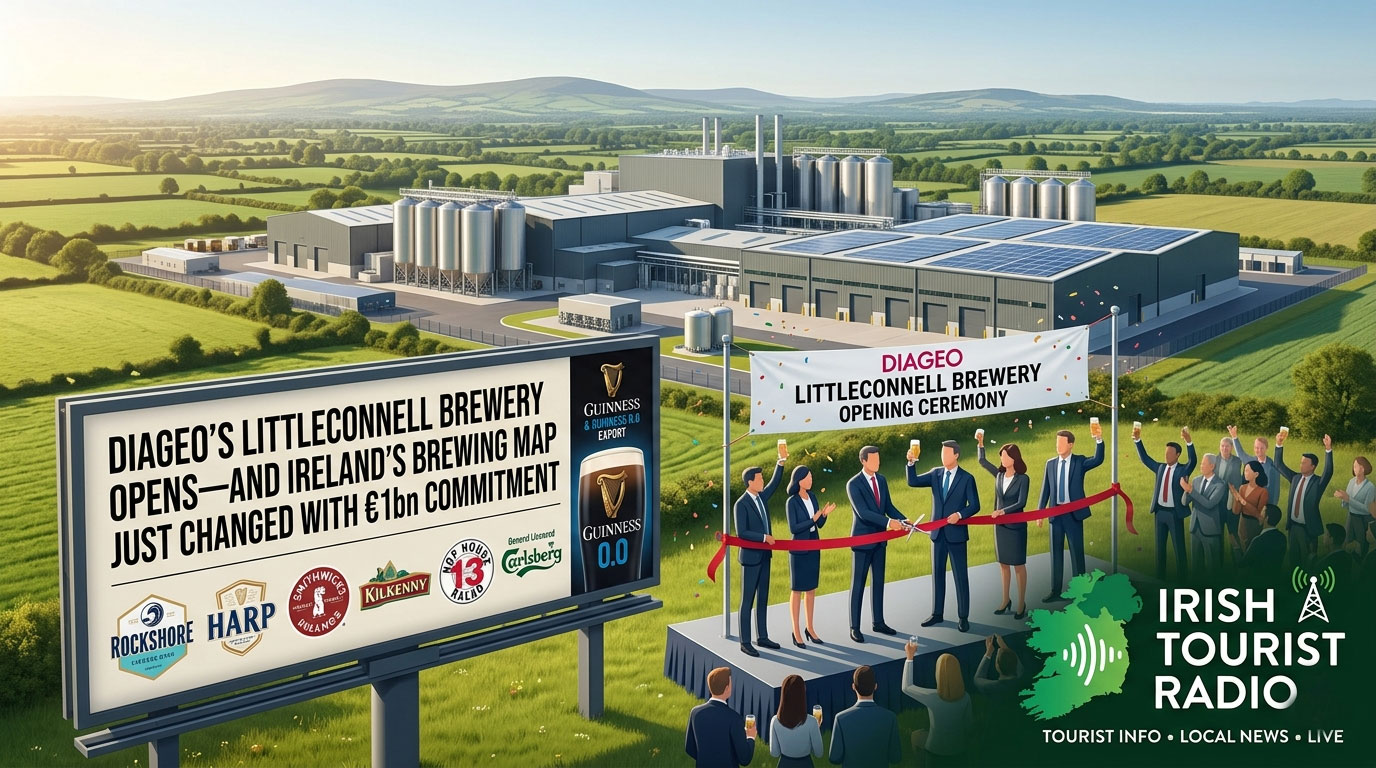

A ribbon was cut, champagne was raised, or perhaps something hoppier, and just like that, the Littleconnell Brewery became real. On Monday, May 11, 2026, Taoiseach Micheál Martin and Diageo CEO Dave Lewis stood together on a 40-acre site in Littleconnell, Co Kildare, outside Newbridge, and made official what €300 million and years of construction had quietly promised: Ireland‘s brewing landscape had fundamentally shifted.
The first phase is already producing Rockshore, Harp, Smithwick’s, Kilkenny, Hop House 13, and licensed beers like Carlsberg rolling off lines powered entirely by renewable energy. That matters more than it sounds. By handling these lagers and ales in Kildare, Diageo frees up St James’s Gate to concentrate on what it does best: Guinness and Guinness 0.0, that increasingly profitable alcohol-free variant that’s been quietly outpacing expectations across export markets.
The numbers, though, are where things get genuinely staggering. That initial €300 million investment? It’s just the opening act. Diageo has committed another €400 million for a second brewery on the same site dedicated entirely to Guinness and Guinness 0.0 for export, bringing the Kildare total to €700 million.
Fold that into a broader near €1 billion investment across Ireland from 2020 to 2029, and you’re looking at a company that’s betting heavily, and deliberately, on this island. Worth noting: that figure runs 50 percent higher than what Diageo originally announced back in 2022, which says something about how confidence and demand have grown.
At full capacity, the complete Littleconnell site will produce two million hectolitres annually, making it the second largest brewing operation in Ireland. That’s not a footnote. That’s a structural change to how Irish beer gets made and where it goes in the world.
Two million hectolitres a year. Not a footnote, a structural shift in how Irish beer gets made.
There’s a certain historical irony worth sitting with here. Arthur Guinness was born in Co Kildare. His father managed the Archbishop of Cashel’s estate in Celbridge, so the brand is, in some sense, returning somewhere ancestral. Whether that’s poetic symmetry or convenient marketing copy probably depends on your disposition, but the connection isn’t invented. Ireland’s landscape has long been steeped in legends of giants, and it is quietly fitting that a brewing giant of this scale has chosen to plant its roots in the same storied soil.
Employment figures are more modest than the investment totals might suggest: 50 permanent full-time roles, with 650 people having worked through the construction phase. Brewery 2 will bring additional jobs, but the facility is, by design, technologically intensive, with advanced brewing systems, reduced energy and water usage, and a site built to produce at scale without proportional headcount. Diageo has also signalled that decarbonization efforts at St James’s Gate Brewery will form a central part of its long-term operational strategy across Irish sites. Meanwhile, Dave Lewis is expected to reveal a broader turnaround strategy for Diageo in August, with the Littleconnell investment widely seen as a marker of where the company’s priorities lie.
What the Littleconnell opening actually signals is less about one brewery and more about a deliberate, long-game repositioning. Diageo is expanding at St James’s Gate, investing in Belfast, and now anchoring a greenfield site in Kildare. The ribbon-cutting was tidy and ceremonial. The strategy behind it is anything but small.