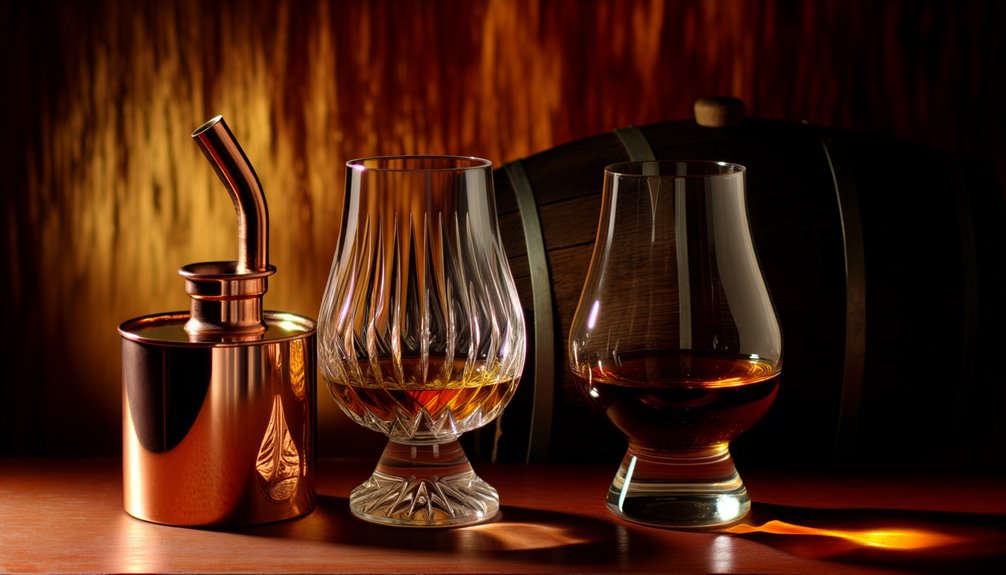

Irish whiskey and bourbon share ancestral ties but diverge markedly in character. Triple-distilled and barley-based, Irish whiskey delivers smooth, warm fruit notes with a three-year aging minimum. Bourbon, requiring 51% corn and virgin charred oak barrels, offers a sweeter, denser experience with vanilla undertones. Irish whiskey encompasses unique pot still varieties, while bourbon boasts straight and wheated options. Their distinct personalities invite spirited comparisons—and perhaps a side-by-side tasting session.

A symphony of amber spirits, Irish whiskey and bourbon stand as pillars in the whiskey world—each with its own distinct character, heritage, and loyal following. These beloved distillations share the same family tree but branch off in delightfully different directions.
Irish whiskey, with roots stretching back to at least 1404, hails from the Emerald Isle, while bourbon—Kentucky's liquid pride—emerged in the late 18th century, partly influenced by Irish immigrants who brought their distilling expertise across the Atlantic.
Centuries apart in birth, these golden spirits share bloodlines—the Irish masters unknowingly parenting America's liquid treasure.
The devil's in the details when it comes to their creation. Irish whiskey primarily features barley malt, undergoes triple distillation (bourbon stops at two), and must age a minimum of three years in various oak vessels.
Bourbon, that sweet-talking American cousin, requires at least 51% corn in its mash bill—hence its characteristic sweetness—and legally must rest for at least two years in virgin charred oak barrels, no exceptions.
These production differences manifest in dramatically distinct flavor profiles. Irish whiskey dances across the palate with remarkable smoothness—light, warm, and often kissed with fruity notes. The natural sweetness comes from malted barley grains which contributes to its approachable character for whiskey newcomers. While bourbon offers a sweet caramel profile, Irish whiskey delights with its warm, spicy notes that make it instantly recognizable.
Bourbon, meanwhile, swaggers with a denser mouthfeel and unmistakable vanilla, caramel, and oak characteristics (thank those new charred barrels for that particular magic). One sips like spring sunshine, the other like autumn twilight.
The Irish tradition offers impressive variety: single malt, pot still (a uniquely Irish style using malted and unmalted barley), grain, and blended options. The celebrated single pot still variety represents a distinctively Irish contribution to whiskey craftsmanship, utilizing both malted and unmalted barley in its production.
Not to be outdone, bourbon counters with straight, wheated, high-rye, and blended varieties—each with passionate defenders.
At the end of the day (or more accurately, at the end of a long one), choosing between these spirits isn't about superiority but preference.
Do you crave the triple-distilled smoothness and subtle complexity of the Irish tradition, or the bold, sweet embrace of America's native spirit?
The beauty lies not in declaring a winner but in appreciating how these amber cousins—separated by an ocean and centuries of tradition—continue to captivate drinkers worldwide.