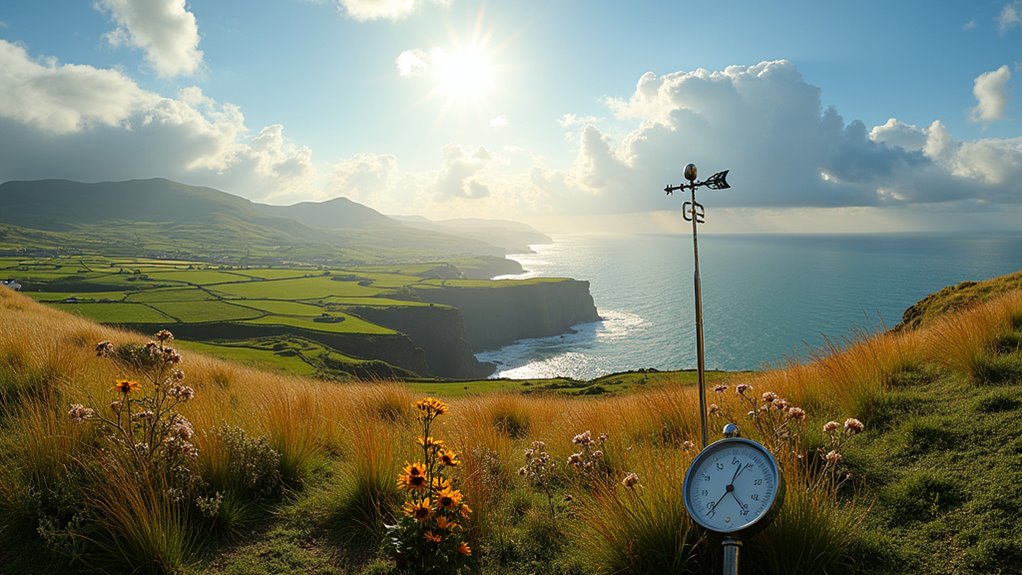

While meteorologists caution against long-term certainty, Ireland’s weather outlook for the coming months suggests a distinctly warmer trend than usual—with temperatures expected to climb 0.5 to 1.0°C above average during May, June, and July.
Met Éireann’s provisional data has already shown signs of this warming pattern, with February 2025 registering as the 16th warmest on record at 1.02°C above the long-term average.
February 2025 has already signaled the warming trend, marking the 16th warmest on record—a full degree above the historical average.
The temperature surge won’t be uniform across the island, though certain regions—yet to be specifically identified—might experience remarkable highs of up to 25°C. It’s a tantalizing prospect for sun-starved Irish citizens who’ve grown accustomed to peering skeptically at forecasts promising warmth that often dissolves into familiar drizzle.
Recent patterns offer cause for optimism, with some areas already experiencing highs of 22°C and more sunshine breaking through in western counties than their eastern counterparts.
The coming bank holiday weekend may bring a slight temperature dip—a classic Irish weather tease—but the overall trajectory points upward.
Sea surface temperatures tell a similar story, running 0.5 to 2.0°C above normal, potentially influencing coastal weather patterns throughout the summer months.
It’s the maritime equivalent of turning up the thermostat, albeit one controlled by oceanic currents rather than human fingers.
Rainfall projections remain characteristically murky—February 2025 delivered 129.8 mm nationwide (122% of the long-term average), with southern regions considerably wetter than northern ones. The contrast was particularly evident at Cork Airport which recorded the wettest conditions at 213.4 mm rainfall.
Similar regional variations could emerge in the coming months, with some areas potentially experiencing drought-like conditions while others reach for umbrellas.
The absence of storm predictions in current forecasts suggests relatively settled conditions, though Ireland’s weather has a notorious habit of rewriting forecasts on short notice. Early May is expected to have lower than average precipitation with high pressure dominating east of Ireland.
Those planning outdoor activities might do well to remember the quintessentially Irish weather maxim: hope for the best, pack for the worst, and don’t be shocked by either extreme—especially in those “surprising regions” where the mercury might surge to Mediterranean heights.