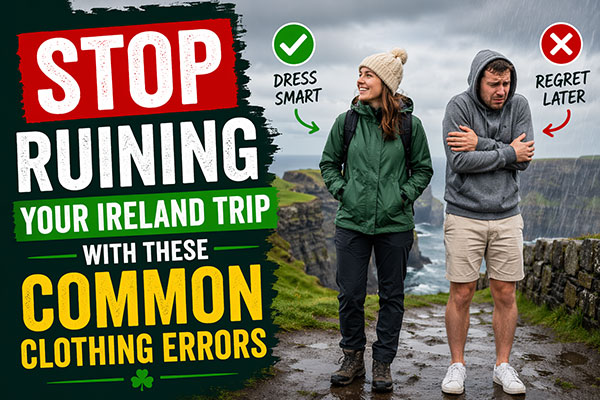

Many travelers arrive in Ireland clutching visions of rolling emerald hills and charming pub crawls, only to spend their first soggy afternoon regretting every clothing decision they made back home. The mistakes are remarkably consistent and remarkably avoidable.
Start with footwear, because nothing derails a trip faster than wet, blistered feet. White sneakers, fashionable on city pavements back home, become muddy disasters within an hour on Irish terrain. Non-waterproof shoes surrender immediately to the country’s frequent drizzle, and boots without proper grip turn rain-slicked coastal paths into personal slapstick performances. The fix is straightforward: waterproof boots with genuine grip, paired with wool socks that maintain warmth even when damp.
Waterproof boots with genuine grip aren’t a luxury in Ireland, they’re the difference between sightseeing and suffering.
Then there’s the jacket situation specifically, the absence of one. Travelers who leave their waterproof jacket behind, reasoning that “it probably won’t rain that much,” are statistically wrong about Ireland. An umbrella sounds like reasonable backup until coastal winds render it a useless, inverted catastrophe. A hooded, windproof, waterproof jacket isn’t optional equipment here; it’s the single most important item anyone packs for the Irish countryside, where exposure to the elements isn’t dramatic, whether it’s simply Tuesday.
Layering, meanwhile, remains one of those concepts people understand intellectually but ignore practically. Bulky sweaters feel thorough until the temperature shifts three times before lunch, which it will. A merino wool base layer, a mid-layer fleece or cardigan, and a windproof outer shell adapt to Ireland’s notorious unpredictability far better than one enormous knitted piece that becomes both too hot indoors and entirely insufficient on a cliff walk.
Coastal cliffs, specifically, amplify cold in ways that humble even experienced travelers’ bare legs in shorts. Discover this truth with particular efficiency.
Shorts deserve their own reckoning. Heatwaves in Ireland exist but remain genuinely rare, and coastal winds punish exposed legs without apology. Trousers offer year-round practicality that shorts simply cannot match, given the climate’s stubborn commitment to unpredictability. Similarly, tank tops and skimpy clothing are comfortable in climates that actually earn them feel optimistic to the point of suffering in Irish conditions where loose, warm, layered clothing is the sensible standard.
Accessories introduce their own comedy of errors. Flowy scarves become airborne nuisances in coastal wind; wide-brimmed hats achieve brief, photogenic moments before departing independently toward the Atlantic. Neck warmers and fitted gloves serve far better. And those bright, distinctively “tourist” pieces, the Aran sweater worn as costume rather than clothing, earn recognition from locals in ways that aren’t entirely flattering. Beyond the sweater, avoiding touristy souvenirs like tweed caps as part of your daily outfit will help you blend in and be taken more seriously by the people you meet.
Finally, darker clothing colors handle Ireland’s inevitable mud encounters with considerably more dignity than lighter alternatives. Packing for Ireland isn’t complicated—it just requires honest acceptance that the weather dictates the wardrobe, not the other way around. It’s also worth noting that orange is considered offensive on Saint Patrick’s Day and is best avoided entirely when packing for a trip that coincides with the holiday.


