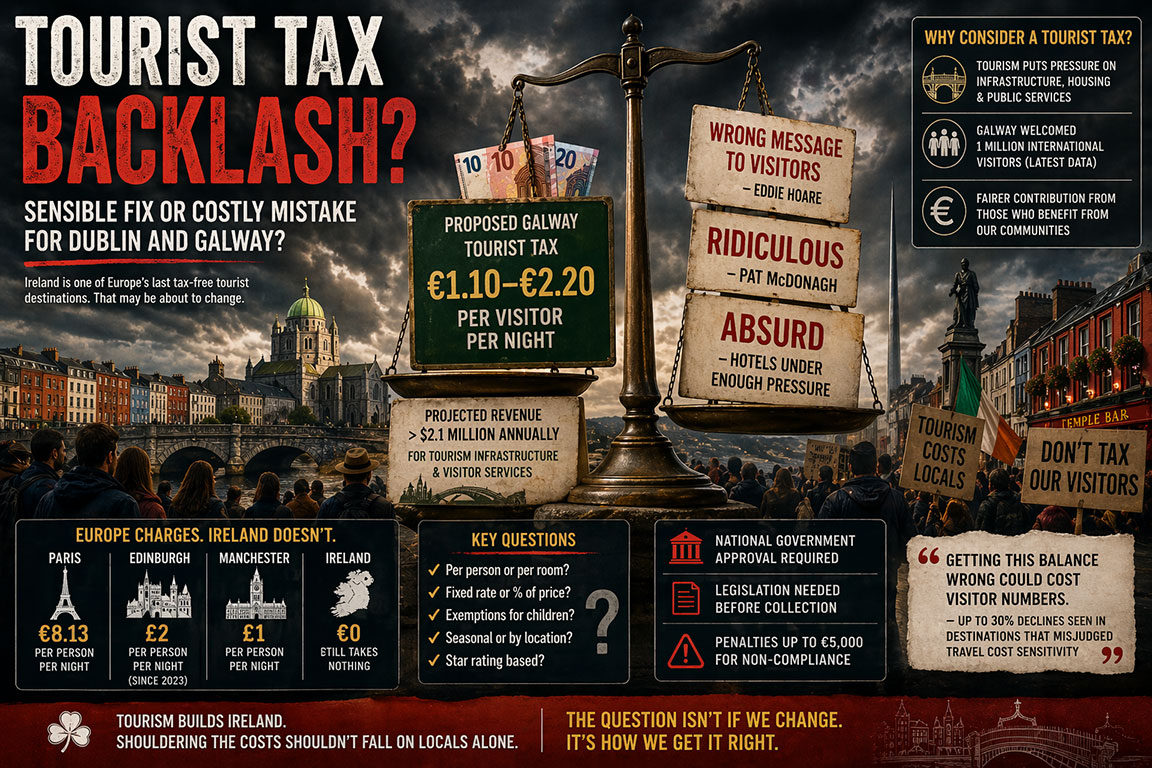
While Ireland’s emerald landscapes and ancient castles have long cast their spell on travelers from across the globe, the country’s tourism magic faces an unexpected plot twist—visitor numbers tumbling like dominoes in a stiff Atlantic wind. January 2025 saw only 339,000 overseas visitors arrive on Irish shores, generating €214 million in revenue—a marked decline from the previous year that has industry watchers reaching for their worry beads.
Yet American travel planners remain stubbornly optimistic about the Emerald Isle, even as February’s visitor spending plummeted 31% and the average stay shrank from 6.2 to 5.9 nights. The reasons aren’t hard to fathom: Ireland still delivers that peculiar alchemy of ancient stone circles, pub conversations that spiral into philosophy, and landscapes that make even cynical tourists believe in fairies—at least after their third Guinness.
The numbers tell a sobering story. February 2025 brought only 304,300 foreign visitors to Ireland, marking a dramatic 30% decrease from the same month in 2024. Tourism contributes €6.2 billion annually to Ireland’s economy, making it one of the nation’s largest indigenous industries. As the country’s biggest regional employer, the sector supports countless families across every county from Cork to Donegal. But economic uncertainty has travelers clutching their wallets tighter than a fiddler grips his bow, while Dublin Airport’s passenger cap has throttled inbound traffic from essential markets like Great Britain (which supplies 49% of visitors) and the United States (10%).
Tourism Ireland acknowledges these “softer trends” with the bureaucratic understatement of an organization watching its house catch fire while commenting on the lovely warmth. The challenge isn’t just logistics—it’s perception. Value-conscious tourists from Britain and Europe increasingly view Ireland as an expensive proposition, like ordering champagne when beer would suffice. Geopolitical tensions have further complicated the tourism landscape, creating travel uncertainty that compounds the already challenging situation.
Still, something intangible keeps drawing visitors, particularly Americans, who seem immune to spreadsheet logic when Ireland calls. Maybe it’s the 37% who come to visit family and friends, their hearts overruling their calculators. Or perhaps it’s that ineffable Irish welcome—the ability to make strangers feel like long-lost cousins within minutes of arrival.
As summer approaches and Dublin Airport’s cap lifts temporarily, the real test begins. Can Ireland’s timeless appeal overcome modern economic headwinds? The tourism industry holds its breath, hoping that magic—Irish or otherwise—still trumps mathematics in the end.