Nearly two hundred thousand visitors made their way to County Leitrim in 2019, a respectable number that nonetheless pales beside the tourist hordes descending on Kerry or Cork, yet this overlooked corner of Ireland offers something those overcrowded destinations can’t: the rare luxury of having an entire lakeside trail, a medieval ruin, or a traditional pub session almost entirely to oneself.
The numbers tell a curious story. While Leitrim’s tourism economy generated nearly €50 million and sustained 1,120 jobs before the pandemic, it represented just 14% of Ireland’s Hidden Heartlands‘ total visitor revenue. This mathematical modesty might discourage some, but therein lies the paradox: Leitrim’s relative obscurity preserves exactly what mass tourism tends to destroy. The county’s landscapes, those rolling drumlins, reed-fringed lakes, and bog-crossed valleys, remain mercifully uncluttered by tour buses and selfie sticks.
Recent years haven’t been kind to Leitrim’s tourism sector. The summer of 2024 saw a particularly brutal decline, with over half of local businesses reporting fewer visitors than the previous year. Only 24% witnessed any increase in customer volume numbers that would send tourism boards into panic mode elsewhere. Rising operational costs and Ireland’s famously temperamental weather conspired against the county’s hotels, restaurants, and pubs, creating what industry insiders describe as an “uncertain outlook” for 2025 (though when has the outlook for Irish tourism ever been certain?). The weather proved particularly devastating for caravan and camping operators, with 82% citing it as their primary concern during what should have been peak season.
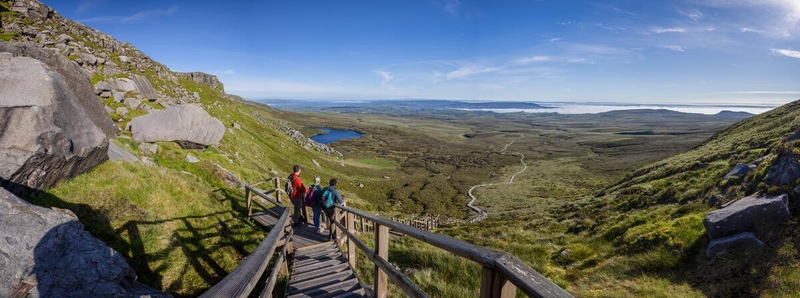
Yet this economic vulnerability masks something profound. Leitrim’s modest slice of the Wild Atlantic Way, that marketing marvel that transformed Ireland’s western seaboard, barely registers compared to Clare’s dramatic cliffs or Donegal’s windswept beaches. But the county compensates with its inland mysteries: fishing spots known only to locals, cycling routes that wind through villages where time genuinely seems to have paused somewhere around 1987, and hiking trails where encountering another human feels like an event worth noting in one’s diary.
Autumn: When Leitrim’s Hidden Magic Truly Emerges
If Leitrim is overlooked in summer, it becomes positively invisible in autumn, and that’s precisely when it transforms into something approaching the sublime. The seasonal shift reveals the county’s true character, when those rolling drumlins and reed-fringed lakes acquire a melancholic beauty that no amount of marketing could adequately capture.
Glencar Waterfall, famously featured in W.B. Yeats’ poem ‘The Stolen Child’, becomes particularly enchanting when autumn’s changing leaves create a stunning backdrop to its cascading waters. The 7km Glencar Hill Walk, starting from the car park, offers solitude that would be impossible at more celebrated Irish attractions. The easy paved pathway to the waterfall provides beautiful views of Glencar Lake, where the autumn mist often lingers well into the morning, creating an atmosphere that feels borrowed from Celtic mythology.
The Leitrim Way, one of Ireland’s 44 National Waymarked Trails, takes on a different character entirely when walked in autumn’s crisp air. While summer brings midges and crowds, autumn offers clear sightlines and the satisfying crunch of fallen leaves underfoot. The River Shannon and its tranquil lakes provide opportunities for peaceful cruising, where the likelihood of encountering flotillas of other tourists approaches zero.
For those seeking authentic cultural experiences, autumn evenings in places like Charlie Farrelly’s cosy bar in Carrigallen, one of Ireland’s oldest traditional pubs, offer something increasingly rare: traditional music sessions and singalongs that exist for their own sake rather than tourist entertainment. The TeaSHED Café overlooking Glencar Lake serves homemade food to visitors who’ve earned their meal through genuine exploration rather than Instagram choreography.
Even spots like Hag’s Leap offer incredible views without the theatrical drama that tourism boards usually demand. In autumn, when the light falls differently across the landscape and the air carries that distinctive Irish clarity, these modest wonders reveal their true worth to anyone willing to seek them out.
The Strategic Tourism Framework for 2023-2027 speaks earnestly about “sustainable tourism” and “preserving landscapes while enhancing visitor experiences,” bureaucratic language that somehow misses the point. Leitrim doesn’t need enhancement; it needs recognition for what it already is: Ireland’s answer to those seeking authentic experiences without the theatrical production that tourism so often becomes. The national trend of visitors increasingly choosing to stay with friends or relatives, 31% of all foreign arrivals in May 2025, suggests travelers are already seeking more genuine connections than standard tourist offerings provide. Many locals have expressed divided opinions on whether increased tourism would benefit their community or threaten their cherished way of life.
The irony isn’t lost on anyone paying attention. While May 2025 saw Ireland’s overall inbound tourism decline by 10%, with visitors staying slightly longer but arriving in smaller numbers, Leitrim’s tourism bodies scrambled for governmental support. They’re fighting to maintain momentum in a place that never really had momentum to begin with, and perhaps that’s precisely its charm.
For travelers exhausted by Instagram-optimized destinations and queue-managed attractions, Leitrim offers something radical: the possibility of genuine discovery. In an era when every corner of Ireland seems catalogued, hashtagged, and reviewed to death, this overlooked county remains stubbornly, beautifully itself, economically precarious, perhaps, but spiritually intact. And in autumn, when the tour buses retreat and the landscape settles into its most honest season, Leitrim’s true treasure reveals itself to those patient enough to look.