While the Atlantic winds have carved the Cliffs of Moher‘s dramatic stone faces over millennia, it’s the steady erosion of solitude, not sandstone, that defines the landmark today. Picture seventy-eight massive tour buses converging on a single parking lot by eight in the morning, disgorging tourists like clockwork, and you’ll understand why Ireland’s most famous natural wonder has become a cautionary tale about loving a place to death.
The erosion of solitude defines the Cliffs of Moher more than the erosion of stone.
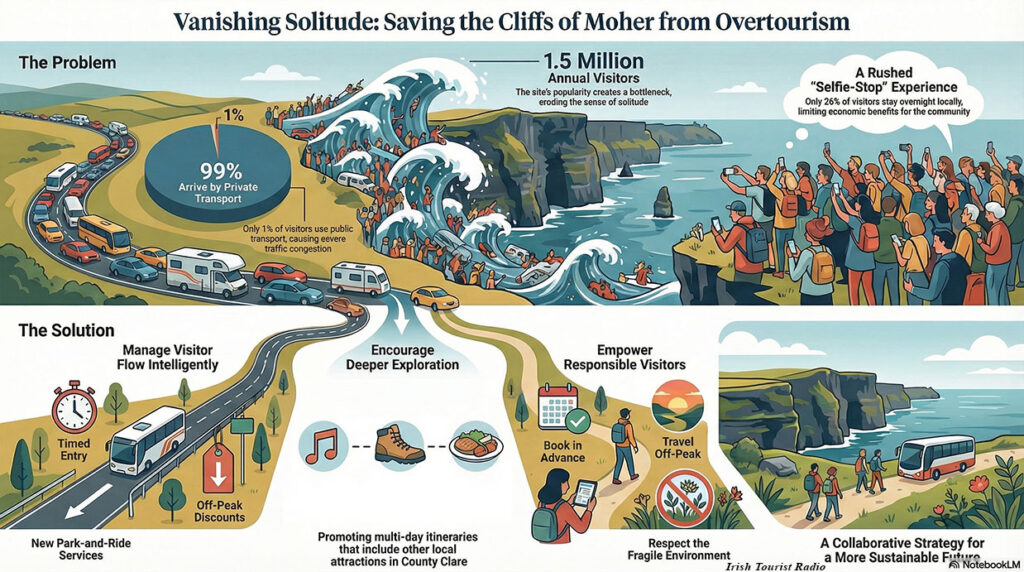
The numbers tell their own story. Nearly 1.5 million people descended on these cliffs in 2024, an eight percent jump from the previous year. That’s 57% of every American who sets foot in Ireland, making the pilgrimage alongside visitors from over 100 countries. The site has transformed into what amounts to a mass-tourism assembly line, where 49% arrive by car and coaches deliver thirty-three passengers at a time (up from twenty-six in 2019, because efficiency).
What makes this particularly absurd is that only 1% of visitors bother with public transport. Everyone else either drives or rides in those behemoth buses that cram the entrance area before most people have finished their breakfast. The result? Peak-time capacity problems that would make a theme park operator wince.
Clare County Council, which pockets €13.8 million annually from this operation, has resorted to desperate measures: discounts for off-peak coach bookings, extended evening hours during summer, and even automatic exit gates to speed up the exodus. Despite these efforts, the Cliffs of Moher is currently operating below daily capacity, suggesting the infrastructure could theoretically handle even more visitors than the overwhelming crowds already present.
The irony isn’t lost on anyone paying attention. Visitors claim they want authentic Ireland, rugged landscapes, windswept isolation, that Celtic mystique, but what they actually get is a carefully managed tourist experience shared with thousands of daily companions. It’s scenic, sure, but it’s about as intimate as Times Square on New Year’s Eve.
Some statistics hint at attempts to salvage the situation. Only 26% of visitors stayed overnight in Clare during peak season, and a mere 12% lingered for three nights. Most book their tickets after already arriving in Ireland (57%), suggesting spontaneous decision-making rather than thoughtful trip planning.
Millennials comprise 40% of the crowd, families 44%, demographics that skew toward quick photo opportunities rather than contemplative nature appreciation. The attraction reported February 2025 numbers consistent with the previous year, indicating the overwhelming visitor pressure shows no signs of abating.
The 2025 numbers offer a glimmer of something; visitor volume dropped 11% through July, and spending fell nearly 15%. Whether that’s economic headwinds or emerging awareness that mass tourism diminishes what made a place special remains unclear.
Meanwhile, coach operators have pulled back slightly, with 8,200 fewer buses than in 2019. Local residents increasingly voice concerns about geological preservation as concentrated foot traffic accelerates erosion along these fragile coastal edges.
The Cliffs of Moher generated €18 million in local economic impact last year, so nobody’s suggesting the gates close tomorrow. But there’s something fundamentally broken when natural grandeur becomes industrial-scale entertainment, when the experience of standing before an ancient geological wonder gets reduced to selfie logistics and visitor flow optimization.
The cliffs themselves remain magnificent, it’s just increasingly difficult to experience them as anything other than a crowded obligation on Ireland’s greatest-hits tour.
Moving Toward Sustainable Tourism at the Cliffs
Fortunately, all sides are now scrambling for solutions. Clare County Council and Fáilte Ireland have unveiled a “Burren & Cliffs” masterplan that explicitly calls for partnerships and off‑season marketing to spread crowds and encourage longer stays failteireland.ie. For example, the draft strategy highlights an Integrated Traffic & Transport Plan and a formal Visitor Management Plan to better distribute tour buses and control daily capacity. In practice, this means new park & ride shuttles, timed entry enforcement, and upgraded cliff‑top trails to improve flow. The 2020 Burren‑Cliffs development plan even urges tourism operators to include overnight stops in County Clare (rather than tight day‑trip loops) and to promote alternative itineraries through sites like Loop Head, Holy Island, and the Burren lowlands. failteireland.ie.
-
Government & Agencies: Invest in coordinated transport (more public buses, park‑and‑ride hubs, traffic control) and enforce capacity limits. Clare’s new “Burren & Cliffs Explorer” shuttle bus (launching May–Aug 2025) already links seven towns to the Cliffs via free timed‑tickets travelandleisure.com. Such shuttle services and upgraded coastal walks (as suggested in the masterplan) will help avoid 78 buses bottling up the main carpark. Authorities are also exploring smaller coach licensing, one‑way coastal loops, and even dynamic pricing or levies on oversize groups failteireland.ie.
-
Tour Operators & Guides: Adjust itineraries and vehicles to be less boom‑and‑bust. Tour companies could favor smaller coaches (33‑passenger buses, not behemoths) and package Cliffs visits as part of longer, immersive routes. Pre‑arranged overnight tours in Clare – for example pairing the Cliffs with Doolin music, Burren hikes or a Loop Head ferry – would turn a rushed selfie‑stop into a multi‑day experience. Tour leaders should highlight local attractions off the beaten path (e.g. holy wells, craft workshops, Burren geology walks) to disperse visitors beyond the main overlook failteireland.ie.
-
Local Businesses & Communities: Create reasons to linger in Clare. Locals can host events and develop new experiences (summer music and storytelling trails, farm‑to‑table food tours, guided nature walks) that capture tourist interest outside peak months. More accommodation options – from B&Bs in coastal villages to family-run eco‑lodges – would turn a single‑day trip into a multi‑day stay. In short, villagers and entrepreneurs should share the story of the Burren and Cliffs (through festivals, training local guides, farm gateways, etc.) so visitors engage with the essence of the place, not just its Instagram backdrop failteireland.ie.
-
Visitors & Tourists: Finally, travelers themselves must adapt. Simple steps can make a big difference: book ahead and use timed tickets or the new shuttle (remember the Cliffs’ visitor centre strongly advises booking a week in advance, travelandleisure.com), and travel off-peak – for instance, arriving early or late rather than between 11 am and 4 pm when crowds peak. Opt for Bus Éireann route 350 or the Burren Explorer shuttle instead of a private car, and consider skipping the site if it’s stormy (many tours substitute an indoor activity with refunds under “Status Orange” conditions). Above all, respect the environment: stay on marked paths, take litter home, and follow the Burren Geopark’s “Tourism for Conservation” guidelines, which remind us we’re guests on sensitive private land, Failte Ireland. cliffsofmoher.ie.
Importantly, signs of progress are already visible. Coach traffic has eased slightly (2025 saw 8,200 fewer coaches than 2019 levels, cliffsofmoher.ie) and the Cliffs’ management is hitting environmental targets (per‑visitor waste, water, and energy use have fallen sharply, with recycling now around 70%). These efforts – combined with new public transport and richer local experiences – show what can happen when everyone pulls together. It won’t solve overnight, but with creativity and cooperation from officials, operators, communities, and tourists, the Cliffs of Moher can remain majestic without feeling like a theme-park madhouse.
From Mass Tourism to Meaningful Travel at the Cliffs of Moher
Fixing the overcrowding at the Cliffs of Moher doesn’t require fewer visitors; it requires better journeys. Sustainable tourism solutions such as public transport incentives, timed entry systems, and overnight stays in County Clare can dramatically improve the visitor experience while protecting one of Ireland’s most iconic natural landmarks. By encouraging tourists to explore beyond the main viewing platforms into the Burren, Loop Head, Doolin, and Clare’s coastal villages, pressure on the cliffs can be reduced while local communities benefit more evenly.
Collaboration is already pointing the way forward. Clare County Council, local businesses, tour operators, and conservation groups are beginning to align around smarter visitor management, smaller group travel, and off-peak experiences. When visitors are nudged to arrive earlier or later, stay longer, and travel more thoughtfully, the Cliffs of Moher regain what made them special in the first place: space, silence, and a sense of scale that no crowd can manufacture.
If the Cliffs of Moher are to remain a symbol of Ireland’s wild Atlantic beauty rather than a warning about overtourism, the answer lies in slowing the pace. A more mindful approach to travel, one rooted in respect, curiosity, and tim,e can ensure that future generations experience the cliffs not as a crowded obligation, but as a place of genuine wonder