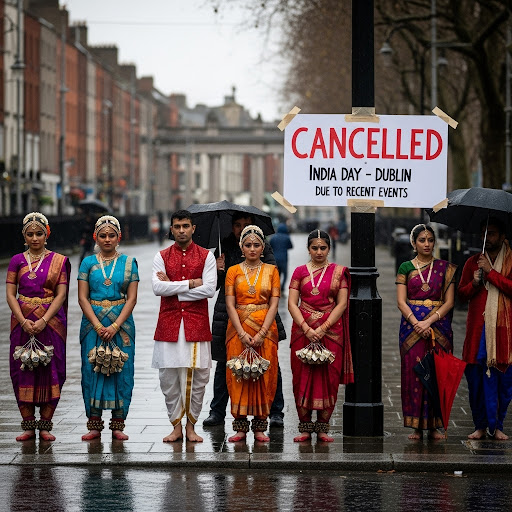

After nearly a decade of vibrant celebrations that transformed Dublin’s Phoenix Park into a kaleidoscope of saris, samosas, and classical dance performances, India Day has been abruptly cancelled not because of rain (this is Ireland, after all) or budget cuts, but due to something far more sinister: a wave of violent attacks targeting the very community the festival was meant to celebrate.
The Ireland India Council’s announcement landed like a stone in still water, rippling outward through WhatsApp groups and family dinner conversations across Dublin’s Indian diaspora. Since 2015, the August gathering at Farmleigh House had become something of a sacred ritual, thousands of families converging for five hours of unapologetic cultural immersion, where Irish kids learned to wrap themselves in colorful fabrics while their parents tentatively sampled curry that actually contained spices (revolutionary concept in certain Dublin suburbs).
Sacred August ritual shattered thousands of families now questioning their place in Dublin’s increasingly hostile landscape.
Now, that tradition lies broken, postponed indefinitely while the community grapples with an uglier reality.
The details remain frustratingly opaque. When pressed for specifics about these “alarming” attacks, the Gardaí offered nothing but bureaucratic silence, no statistics, no incident reports, just the kind of institutional shoulder-shrug that makes you wonder if they’re protecting privacy or protecting themselves. Recent incidents include disturbing reports of an Irish-Indian child being assaulted and racially abused while simply playing outside their home.
What we do know comes filtered through diplomatic channels: the Indian Embassy warning its nationals to avoid deserted areas after dark, as if Dublin had suddenly become some noir film where danger lurks in every shadow.
Deputy Prime Minister Simon Harris condemned the violence with the requisite political gravitas, but condemnation feels hollow when families are canceling their evening walks and reconsidering whether that late-night grocery run is worth the risk.
The Ireland India Council’s co-chairman expressed “deep regret” about the postponement, corporate speak for what must be genuine anguish at watching years of bridge-building crumble under the weight of hatred.
Consider what’s being lost here: India Day wasn’t just about bhangra performances and fashion shows (though those were spectacular). It represented something rarer, an authentic cultural exchange in a world increasingly suspicious of difference. The event featured craft stalls where artisans displayed traditional Indian handicrafts alongside Irish vendors, creating unexpected conversations between cultures.
Free admission, family-friendly programming from eleven to five-thirty, the kind of event where integration wasn’t a government policy but a lived experience, messy and beautiful and real.
The racist violence that prompted this cancellation reveals an uncomfortable truth about modern Ireland, a country that prides itself on hospitality yet apparently harbors enough animosity to make an entire community question its safety.
The Council emphasized their “responsibility” toward community wellbeing, a polite way of saying they refuse to paint targets on people’s backs by gathering them in one location.
August 17, 2025, will pass without the usual explosion of marigolds and music in Phoenix Park. Instead of celebrating what connects these two cultures, Dublin must reckon with what’s driving them apart and whether the Ireland that welcomes everyone actually exists beyond tourist brochures and political speeches.