

The 1899 Founding by Yeats, Lady Gregory, and the Gaelic Revival
When the Irish Literary Theatre opened its doors in 1899, it arrived not with fanfare but with something harder to quantify: a sense of possibility, fragile and fierce, that Ireland might discover its own voice on its own stages.
William Butler Yeats, Lady Augusta Gregory, and Edward Martyn formed an unlikely triumvirate of poet, aristocrat, playwright, bound bythe conviction that Irish poetic drama could forge something essential, something capable (in Yeats’s admittedly grandiose estimation) of transfiguring an entire nation.
They weren’t starting from scratch, exactly. The Celtic Revival was already gathering momentum, that sprawling cultural movement aimed at excavating Irish folklore, language, and identity from beneath layers of colonial influence.
What the theatre offered was a focus on a physical space where deeper emotions could breathe, where national unity might somehow crystallize through carefully chosen words performed by Irish actors for Irish audiences. Today, these historical venues are part of Ireland’s megalithic wonders that span over 5,200 years of rich cultural narrative.
The mission was ambitious, perhaps impossibly so, but obscurity had never deterred dreamers before. Early productions included Martyn’s “The Heather Field” and Yeats’s “The Countess Cathleen,” works that tested whether Irish audiences were ready to see their own stories reflected back at them. By 1904, the venture had evolved into the Abbey Theatre, with Yeats and Lady Gregory at its helm.
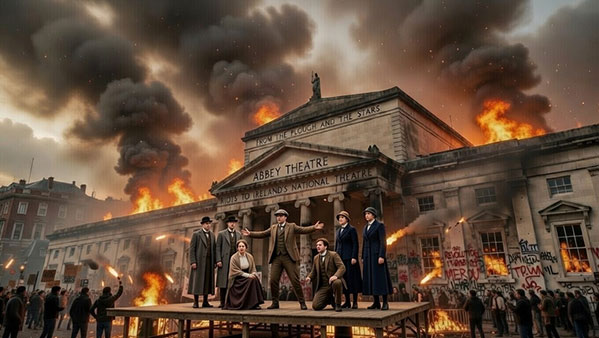
From The Plough and the Stars Riots to Ireland’s National Theatre
The 1920s should have been a period of celebration for the Abbey after all, they’d survived occupation, rebellion, and near-bankruptcy, secured that groundbreaking state subsidy in 1924, and finally seemed poised to flourish as Ireland’s theatrical voice.
Instead, Sean O’Casey arrived like a lit match tossed into a powder keg. Between 1923 and 1926, the theatre staged three of his plays: The Shadow of a Gunman, Juno and the Paycock, and the incendiary The Plough and the Stars, each forcing audiences to confront the messy, unglamorous realities of Ireland’s violent birth.
His dramatization of the Easter Rising in The Plough and the Stars proved particularly provocative, stripping away romantic nationalism to reveal the chaos underneath. The opening night in January 1907 had already demonstrated the theatre’s capacity for sparking controversy when Synge’s The Playboy of the Western World ignited civil disturbances that would become known as the Playboy Riots. Nationalists criticized Synge’s portrayal of violence and barbarism in Irish culture, seeing it as an insult to the nation’s character.
The theatrical confrontations reflected the larger struggle against cultural suppression that had fueled revolutionary sentiment across Ireland.
The theatre nearly collapsed again, this time from controversy rather than finances, but O’Casey’s unflinching honesty also breathed new energy into the institution.
Here was drama that mattered, raw, challenging, and unapologetic. The Abbey had become Ireland’s national stage by refusing to flatter its national myths.
Stepping Behind the Curtain: Visiting the Abbey Today
For those who wish to go beyond the performance, the Abbey Theatre offers a variety of immersive experiences. The National Theatre Tour provides a behind-the-scenes look at how productions move from “page to stage,” allowing visitors to explore the 1960s building, view the extensive portrait collection of iconic Irish writers and actors, and walk in the footsteps of legends like Yeats and Synge. These guided tours typically last an hour and run several days a week. For a more casual visit, Pegeen’s Café, located within the theatre and named after the heroine of J.M. Synge’s The Playboy of the Western World, offers a unique atmosphere with furniture sourced directly from the Abbey’s prop room.
Before the Show: Dining in the Heart of Dublin
The area surrounding Marlborough Street is a hub for “pre-theatre” dining, offering everything from fine dining to historic gastro-pubs. For a Michelin-starred experience, D’Olier Street is just a five-minute stroll away, while Hawksmoor Dublin, located in a beautifully restored former bank, is famous for its Irish-bred steaks. If you prefer to stay on-site, the Abbey and Peacock Bars open an hour before each show, serving Irish craft beers, gins, and sharing platters that can be pre-ordered for the interval.
After the Final Bow: Where the Conversations Continue
The tradition of discussing the night’s performance over a pint remains a staple of the Dublin theatre experience. Directly across the street is The Flowing Tide, a classic haunt for actors and audiences alike. A few steps further on Abbey Street sits The Oval Bar, a historic Victorian pub that uniquely survived the 1916 Rising and remains a favourite for its traditional atmosphere. For those looking for a “theatrical” vibe with walls lined with photos of Irish actors, The Trocadero on St. Andrew’s Street has been a post-show institution for decades.
Historical Context: The Legacy of the Abbey
These modern amenities sit atop a foundation of revolutionary history. The Abbey was not only a “laboratory” for transforming ancient legends into sovereign drama, but also a catalyst for national pride. By promoting the “deeper emotions of Ireland” through the works of Lady Gregory and W.B. Yeats, the theatre successfully moved revolutionary fervour from the stage to the streets, helping to establish Ireland as an independent centre of creative energy. Today, it continues this mission as the world’s first state-subsidised theatre, a status it has held since 1924.