How the Emerald Isle Shaped America’s Great Abolitionist
In August 1845, a 27-year-old fugitive slave named Frederick Douglass stepped ashore in Dublin, expecting to stay just four days. He would remain in Ireland for four transformative months. What began as a brief stopover on his way to Britain became a profound awakening that would shape not only his identity as a free man but also his evolution from an American abolitionist into a global champion of human rights. During Black History Month, we remember this extraordinary journey through Ireland, a journey that connected the struggle for African American liberation with Ireland’s own fight for freedom, and created bonds of solidarity that endure to this day.
A Fugitive’s Welcome in Dublin
Frederick Douglass arrived in Dublin on August 31, 1845, having sailed from Boston via Liverpool. The publication of his autobiography, Narrative of the Life of Frederick Douglass, an American Slave, just three months earlier had made him both famous and dangerously vulnerable. In America, the Fugitive Slave Act meant he could be captured and returned to bondage at any moment. But in Ireland, for the first time in his life, Douglass felt truly free. He was hosted by Richard D. Webb, a Quaker printer and founding member of the Hibernian Anti-Slavery Society, at Webb’s home on Great Brunswick Street (now Pearse Street). Together, they would publish the first Irish edition of his Narrative, with Douglass asserting his independence by writing his own preface, a departure from the American editions where white abolitionists had provided ‘validations’ of his story.
The Black O’Connell Meets The Liberator
On September 29, 1845, Douglass attended a packed meeting at Conciliation Hall in Dublin to hear his great hero, Daniel O’Connell, speak about repealing the union between England and Ireland. Initially standing at the back of the crowded hall, Douglass was introduced to O’Connell by his son, John. O’Connell, known as ‘The Liberator’ for his campaign for Catholic emancipation, was a fierce abolitionist who famously refused to shake hands with anyone until he knew their stance on slavery. Upon meeting Douglass, O’Connell invited him to address the audience and playfully dubbed him ‘the black O’Connell of the United States.’ It was during this historic encounter that Douglass adopted O’Connell’s famous mantra ‘Agitate, agitate, agitate’ which would become the cornerstone of his activism for decades. O’Connell’s commitment to non-violent agitation and his refusal to accept ‘bloodstained’ donations from American slaveholders deeply impressed Douglass and helped transform him from a single-issue abolitionist into a champion of universal human rights.
Speaking Truth in Dublin’s Historic Venues
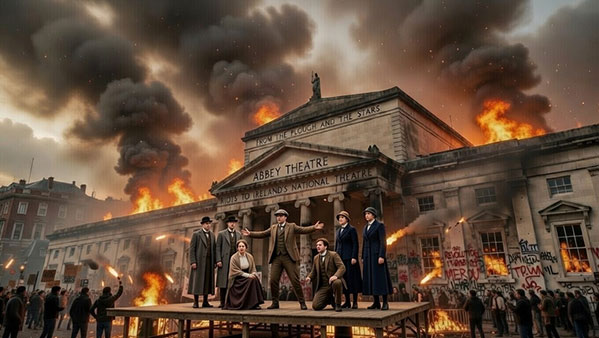
During his six weeks in Dublin, Douglass delivered powerful lectures at several historic venues. He spoke at the Royal Exchange (now Dublin City Hall) on September 3, 1845, establishing his presence as a masterful orator. He addressed audiences at the Quaker meeting house on Eustace Street, where he critiqued American churches for their complicity in slavery. At the Music Hall on Abbey Street, he used actual whips and chains as visual aids to illustrate the brutal reality of bondage. One of Douglass’s most memorable experiences in Dublin came when the Mayor invited him to dine at the Mansion House, an honor that would have been unthinkable in America at the time. This gesture of equality demonstrated the stark contrast between his treatment in monarchical Ireland and democratic America, where he was still legally considered property.
Finding Family in Cork
In October 1845, Douglass traveled south to Cork, where he spent nearly three weeks and developed some of his deepest Irish friendships. He was hosted by Thomas Jennings, a soda water and vinegar manufacturer who led the Cork Anti-Slavery Society. More significantly, he formed a lasting bond with Jennings’s wife, Jane, and their daughter, Isabel, who served as co-secretaries of the Cork Ladies’ Anti-Slavery Society. The Jennings women organized his lectures and supported his mission with such dedication that Douglass continued to correspond with Isabel long after returning to America. In Cork, Douglass was honored at the Imperial Hotel and delivered a memorable speech at the Cork Temperance Institute. It was here that he met Father Theobald Mathew, Ireland’s ‘Apostle of Temperance,’ and took the teetotal pledge, seeing the sobriety movement as parallel to the struggle for human liberty. Cork’s Mayor, Richard Dowden, attended Douglass’s lecture at the Wesleyan Chapel on October 17, 1845, demonstrating the civic support for his mission.
The Chattel Becomes a Man
Throughout his time in Ireland, Douglass experienced something revolutionary: he was treated as an equal human being. ‘I employ a cab, I am seated beside white people, I reach the hotel, I enter the same door, I am shown into the same parlour, I dine at the same table, and no one is offended,’ he wrote with wonder. In America, even in the ‘free’ Northern states, he was barred from restaurants, forced into segregated train cars, and met with ‘scornful lips’ in churches. But in Ireland, people looked him in the eye and addressed him as ‘Mister.’ He was invited to speak on temperance platforms ‘side by side with white speakers,’ and his opinions on matters beyond slavery carried equal weight. Most powerfully, Douglass described feeling that ‘the chattel becomes a man,’ a profound transformation from being treated as property in a democracy to being recognized as fully human under a monarchy. He didn’t have to gaze around constantly for someone who would ‘question my equal humanity, claim me as his slave, or offer me an insult.’ For the first time in his life, he felt safe.
Belfast and the Chain of Suffering
Douglass spent seven weeks in Belfast from December 1845 through January 1846, hosted by the Belfast Anti-Slavery Society and delivering powerful lectures at the Independent Meeting House. But this period also marked a darker realization. As he arrived, the Great Famine was beginning to devastate Ireland. Douglass witnessed ‘mud huts’ that were ‘literally alive with beggars’ and saw widespread poverty that shocked him profoundly. He drew direct parallels between the suffering of Irish peasants under British colonial rule and the enslaved people on American plantations. This experience led him to articulate the concept of a ‘chain of suffering’ that linked the oppressed across the world, regardless of race or location. He wrote that he would be ‘ashamed’ to speak against American slavery if he closed his heart to the ‘woes of others.’ In 1847, when the famine reached its peak, Douglass demonstrated his solidarity by sending a financial donation to a women’s group in Belfast to aid their relief efforts in western Ireland. While in Belfast, Douglass also purchased his first watch, a real English bullseye,’ which symbolized his transition to manhood and professional independence, representing the self-reliance and punctuality of the free man he was becoming.
The Wider Irish Tour
Douglass’s Irish journey extended beyond the major cities. He delivered lectures in Wexford, Waterford, Youghal, and Limerick. In Waterford, his visit made such an impression that it is now commemorated with a plaque outside a Council building. Throughout these stops, Douglass was consistently aided by members of the Society of Friends (Quakers), who provided him with housing, organized his lectures, and supported his mission. He was not alone on this journey; he traveled with James Buffum, a white American abolitionist, and the Hutchinson Family, a group of singing siblings from New Hampshire who performed at several of his gatherings, marking the first time music was integrated into anti-slavery meetings in Ireland. Across nearly 50 lectures in four months, Douglass spoke about the horrors of American slavery, the complicity of American churches in supporting the institution, and the importance of the temperance movement.
The Women Who Purchased His Freedom
While Douglass’s time in Ireland provided him with confidence and independence, he remained legally enslaved under American law. In December 1846, after he had moved to England, two Quaker sisters, Anna and Ellen Richardson, spearheaded an effort to purchase his legal freedom. They negotiated with Hugh and Thomas Auld, Douglass’s legal ‘owners’ in Maryland, and paid £150 sterling (approximately $711) to secure his manumission. This act was controversial within the abolitionist movement; some argued that paying for his freedom tacitly acknowledged the right of one human to own another. But Douglass countered that as a public figure and father, he could be of more use to the cause as a legally free man who could return to his family without the constant threat of recapture. The support of the Richardson sisters, along with the Irish women who had championed his cause, particularly Jane and Isabel Jennings in Cork, and the women’s groups in Belfast, gave Douglass the financial and moral backing to return to America not as a fugitive, but as a truly free man.
A Transformed Man Returns
In April 1847, Frederick Douglass returned to the United States as a legally free man. He settled in Rochester, New York, and founded his newspaper, The North Star, named after the celestial guide that had helped enslaved people navigate their way to freedom. The transformation that began in Ireland was complete: Douglass had evolved from a fugitive slave who needed white abolitionists to validate his narrative into an independent leader who could write his own preface, set his own course, and speak with his own authority. He had moved from being ‘simply an abolitionist’ to a champion of universal human rights, inspired by O’Connell’s example of fighting for the oppressed ‘the world over’ whether they were Irish Catholics, American slaves, Jews, Maoris, or Aborigines. The mantra ‘Agitate, agitate, agitate’ that he learned at Conciliation Hall became his lifelong creed, and his commitment to non-violent agitation remained steadfast throughout his career as one of America’s greatest orators and reformers.
The Elder Statesman Returns
Forty-two years later, in 1887, Frederick Douglass returned to Ireland as an old man. He came to visit the children of those who had sheltered him and to see how the country had changed. But he also came as a changed man himself, one whose political vision had been shaped by the Irish experience. During this second visit to Dublin, Douglass spoke publicly in favor of Irish Home Rule, advocating for Ireland’s independence from Britain. Upon returning to America, he continued this advocacy at a Home Rule meeting in Washington, declaring that ‘Ireland wants its independence and in justice Ireland should get its independence.’ The memory of the Great Famine, the ‘chain of suffering’ he had witnessed, and the fundamental dignity that Irish people had shown him when his own country treated him as property, all of this convinced him that Ireland deserved to be a free nation. The fugitive slave who found sanctuary in Ireland became a champion of Irish freedom, demonstrating that the struggle for liberty truly was, as he learned from O’Connell, ‘one the world over.’
A Lasting Legacy
The profound connection between Frederick Douglass and Ireland endures to this day. The Frederick Douglass statue at Quinnipiac University in Connecticut depicts the young Douglass wearing a cloak typically worn by Daniel O’Connell, symbolizing ‘The Liberator’s’ lasting influence on his life. The statue also shows Douglass clutching his Narrative in his left hand, the book that made his Irish journey possible, while his outstretched right hand is modeled on President Barack Obama’s, commemorating Obama’s 2011 visit to Ireland. This artistic choice is particularly poignant because Douglass’s own right hand was broken by a pro-slavery mob in 1843 and never properly healed. The use of a future president’s hand symbolizes both the healing of historical trauma and the ultimate success of the struggle for equality that Douglass and O’Connell championed. Throughout Ireland, plaques, commemorations, and continued scholarship honor Douglass’s visit, reminding us that the bonds of solidarity forged in 1845 between the struggle for Irish freedom and African American liberation remain relevant today.
Ireland’s Gift to the World
Frederick Douglass came to Ireland as a fugitive slave seeking temporary sanctuary. He left as a free man and a global human rights champion. Ireland gave Douglass something America could not: the recognition of his full humanity. In return, Douglass gave Ireland and the world a powerful testament to the universal nature of the struggle for freedom. His four months on the Emerald Isle proved that the cause of liberty transcends borders, that oppression wears many faces, and that solidarity between the oppressed is not only possible but essential. During Black History Month, as we remember Frederick Douglass’s extraordinary life, we should also remember Ireland’s role in his transformation. The warmth of Irish hospitality, the example of Daniel O’Connell’s moral courage, the support of Irish abolitionists (especially the women who championed his cause), and even the painful witness of the Great Famine all of these experiences shaped one of America’s greatest leaders. The ‘Black O’Connell’ carried the lessons of Ireland with him throughout his life, proving that sometimes the greatest gifts are the ones we give each other across oceans and centuries: the gift of dignity, the gift of solidarity, and the gift of hope.
—
For Irish Tourist Radio
Black History Month 2026