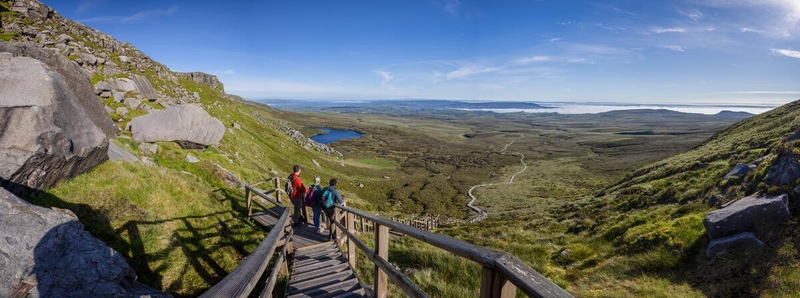
Every spring, a few hundred people gather at the base of Carntogher Mountain in County Derry to do something that sounds vaguely masochistic: walk six kilometers of boulder-strewn terrain in conditions that approximate though never truly replicate the desperation of their famine-era ancestors.
The Emigrant Walk traces the Old Coach Road from Belfast to Derry, a route that mid-nineteenth-century Irish fleeing the Great Hunger would have traveled with whatever possessions they could carry, heading toward ports and the uncertain promise of survival abroad. Local expert Cathy O’Neill leads these guided treks, narrating the journey with stories of famine-struck people whose footsteps quite literally shaped the path beneath modern hikers’ boots. The landscape hasn’t changed much since then, which is either poetic or depressing, depending on your outlook.
Walking the same desperate route 170 years later, guided by stories of those who had no choice but to leave.
What strikes participants first is the physicality of it all. This isn’t a gentle stroll through heritage; it’s a near-barefoot scramble across rugged, unforgiving ground that leaves you acutely aware of every pebble, every uneven surface, every muscle in your legs questioning your life choices.
The ascent up Carntogher takes about 2.5 to 3 hours, and while the panoramic views of Lough Neagh, the Sperrins, and the Mourne Mountains are objectively spectacular, there’s something quietly devastating about realizing these vistas were likely the last glimpses of home for people who had no choice but to leave.
The walk culminates at a summit cairn where participants add their own emigrant stone to the thousands already piled there, a collective memorial that grows with each passing year. It’s a simple ritual, placing one rock among countless others, but the symbolism hits harder than expected. You leave a stone; you take a different one home, engraved as a memento. The exchange feels almost transactional until you understand it represents what emigrants themselves had to do: leave something behind to carry something forward.
The experience extends beyond the mountain itself. Friel’s Bar & Restaurant, built on the site of a famine-era soup kitchen, displays an authentic famine pot and serves nettle soup, the same bitter sustenance that kept emigrants alive during their journey. Tasting it provides a sensory bridge across 170 years, though you’re acutely aware that you chose this discomfort and can opt out whenever you please. The day concludes with a final poitin toast, a traditional Irish send-off that mirrors the bittersweet farewells exchanged by emigrants generations ago.
The landscape shifts dramatically with seasons, breathtaking in spring and summer, brutally harsh in autumn and winter, which somehow makes the whole endeavor more honest. The emigrants didn’t get to choose ideal weather or favorable trail conditions. They left when desperation demanded it, carrying hope and trauma in equal measure across these same boulder-strewn slopes. Many travelers find respite by stopping at a millennium-old pub between Dublin and Galway that has survived since the Dark Ages, providing a tangible connection to Ireland’s resilient past. Those interested in retracing this journey can arrange private and group tours with flexible scheduling to accommodate different needs.
Walking it now, even symbolically, even safely, offers something textbooks cannot: the bone-deep understanding that history wasn’t abstract. It was rocks under feet, hunger in bellies, and impossible choices made on unforgiving ground.
Tips for Visitors (Especially at This Time of Year)
-
-
-
Weather Considerations: Depending on the season, Carntogher and the Sperrins can be quite wild; dress for the elements.
-
Guided vs Self-Guided: Use the Carntogher Heritage Trail map + guide if walking independently; if possible, join a guided walk (like the Emigrant Walk) for deeper context.
-
Combine Activities: You could pair a hike with a cultural stop (An Carn Centre) + a historical stop in Derry (Workhouse or Cemetery) for a full-day itinerary.
-
Book in Advance: For experiences like the guided Emigrant Walk or alpaca trekking, check if you need to book ahead.
Things to Do Around Carntogher & the Derry/Sperrins Region — Seasonal Guide
🌱 SPRING (March–May)
Best for fresh landscapes, wildflowers, and the annual Emigrant Walk.
1. Carntogher Emigrant Walk (Guided)
A moving guided walk tracing famine-era footsteps across Carntogher Mountain.
🔗 https://www.visitmidulster.com/things-to-do/carntogher-heritage-trail-p7626812. Drumnaph Nature Reserve – Spring Woodland Trails
Bluebells, wild garlic, and birdlife at their peak.
🔗 https://www.carntoghercabins.com/things-to-do/3. Seamus Heaney HomePlace
Spring lectures, readings, and poetry events.
🔗 https://www.carntoghercabins.com/things-to-do/4. Sperrin Mountains Hiking
Great visibility and gentler weather for the Slí an Chairn and Iniscarn Forest Trails.
🔗 https://www.visitmidulster.com/things-to-do/walking-and-hiking/sperrin-mountains5. An Carn Cultural Centre Workshops
Irish crafts, storytelling, and seasonal cultural events.
🔗 https://www.carntoghercabins.com/things-to-do/
☀️ SUMMER (June–August)
Warmer days, long evenings, and the best conditions for extended outdoor exploring.
1. Carntogher Heritage Trail (Self-Guided)
Ideal for longer hikes with panoramic views to Lough Neagh and the Mournes.
🔗 https://www.visitmidulster.com/things-to-do/carntogher-heritage-trail-p7626812. Alpaca Trekking Near Carntogher
A fun, family-friendly summer adventure.
🔗 https://www.carntoghercabins.com/things-to-do/3. Glenshane Pass Scenic Drive + Ponderosa Restaurant
Ireland’s highest pub, perfect for sunset dinners.
🔗 https://www.carntoghercabins.com/things-to-do/4. Derry Walls Walk
Mild summer weather makes it ideal to walk the historic 17th-century walls.
🔗 https://en.wikipedia.org/wiki/City_Walls_of_Derry5. Brooke Park in Full Bloom
Victorian-era gardens at their summer best.
🔗 https://en.wikipedia.org/wiki/Brooke_Park
🍁 AUTUMN (September–November)
Moody skies, golden landscapes, the Sperrins at their most atmospheric.
1. Drumnaph Autumn Trails
The forest turns golden with incredible photography opportunities.
🔗 https://www.carntoghercabins.com/things-to-do/2. Heaney HomePlace – Autumn Events
Heaney-inspired harvest readings + local food festivals.
🔗 https://www.carntoghercabins.com/things-to-do/3. Sperrin Mountains Dark Sky Viewing
Clear autumn nights = perfect stargazing conditions in one of NI’s darkest regions.
🔗 https://www.visitmidulster.com4. Friel’s Bar – Nettle Soup & Famine Pot Display
Ideal for cooler evenings; connects directly to your article.
🔗 https://www.carntoghercabins.com/things-to-do/5. Ulster American Folk Park – Emigration Exhibits
Excellent for autumn city breaks; ties beautifully to the Emigrant Walk theme.
🔗 https://en.wikipedia.org/wiki/Ulster_American_Folk_Park
❄️ WINTER (December–February)
Raw, wild, and honest, it is the closest to the conditions emigrants truly faced.
1. Winter Walk on Carntogher (Weather Permitting)
Short daylight, cold winds, and a stark landscape that adds emotional weight to the walk.
🔗 https://www.visitmidulster.com/things-to-do/carntogher-heritage-trail-p7626812. Warm Up at The Ponderosa Bar
Cozy fires, hearty food, and dramatic winter mountain views.
🔗 https://www.carntoghercabins.com/things-to-do/3. An Carn Centre Christmas Markets
Crafts, traditional gifts, Irish-language events.
🔗 https://www.carntoghercabins.com/things-to-do/4. Winter History Tour of Derry
Learn famine, emigration, and industrial-era stories with far fewer crowds.
🔗 https://en.wikipedia.org/wiki/Derry5. Visit the Derry Workhouse Memorial & Famine Graves
A stark but meaningful winter pilgrimage site.
🔗 https://en.wikipedia.org/wiki/Derry_Workhouse
-
-