

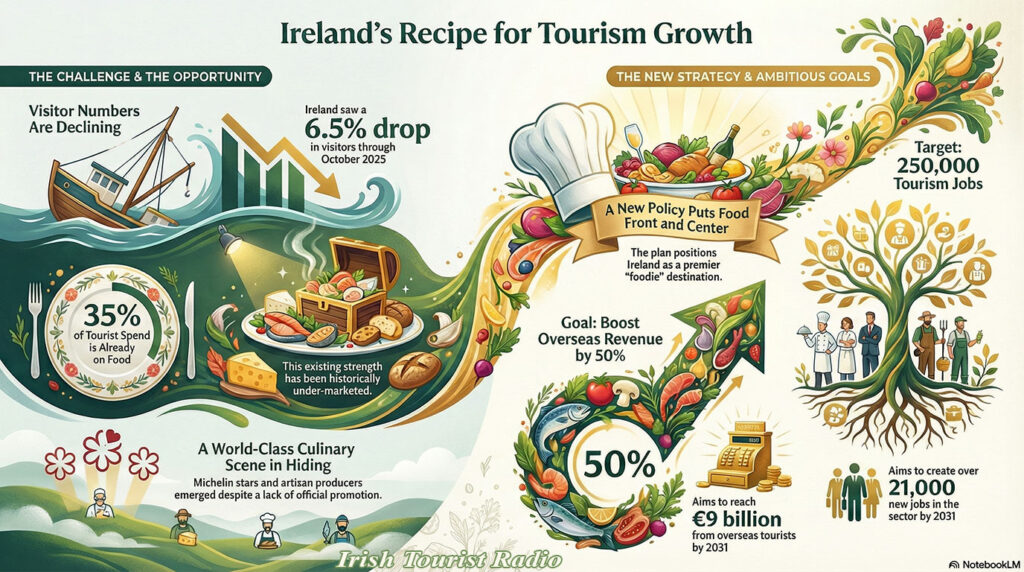
Against the backdrop of declining visitor numbers down 6.5% through October 2025, Ireland has launched an ambitious tourism policy that bets heavily on what visitors have been spending their money on all along: food. Minister Peter Burke disclosed “A New Era for Irish Tourism” at Belvedere House in Mullingar, placing culinary experiences at the center of Ireland’s tourism strategy for the first time. The irony is almost comic; tourists already allocate 35% of their budgets to food and drink, yet the sector has been systematically under-promoted while Ireland chased its reputation for rain-soaked castles and dubious literary pilgrimages.
Ireland finally markets what tourists already pay for: the food they’ve been quietly enjoying while chasing literary ghosts.
The numbers tell a story of aggressive optimism bordering on wishful thinking. The policy targets a 50% revenue increase from €6 billion to €9 billion in overseas tourism alone by 2031, while projecting only a 15% bump in actual visitor numbers. Domestic revenue should climb from €3.6 billion to €5.8 billion, pushing combined totals to €14.8 billion.
Tourism experts have raised eyebrows at this mathematical gymnastics, questioning how Ireland plans to extract substantially more money from marginally more people. The answer, apparently, lies in food trails and week-long culinary holidays that transform casual visitors into committed gastro-tourists.
Food and beverage consumption already accounts for 34% of total visitor spend, a figure that underscores both the sector’s existing strength and its untapped potential. Ireland’s culinary renaissance, complete with Michelin stars, artisan producers, and farm-to-table evangelism, has quietly happened while tourism marketing remained stuck in postcards of green hills.
The new policy seeks to correct this oversight by positioning Ireland as a legitimate “foodie” destination, capitalizing on world-class gastronomy that emerged almost despite official promotion rather than because of it. The initiative includes investment in farm-to-table experiences and food tours to attract culinary enthusiasts from key markets. Visitors will be enchanted by seasonal festivals where traditional Irish dishes showcase the country’s rich culinary heritage.
The broader strategy targets one million additional tourists annually over five years, with emphasis on spreading visitors across less mature destinations and extending the season through Halloween. Employment goals aim for 250,000 tourism jobs by 2031, up from 228,800 currently, while supporting over 46,000 enterprises, 90% of which should adopt advanced digital tools within the timeline. The plan introduces performance targets for Tourism Ireland and Fáilte Ireland to ensure accountability in achieving these ambitious goals.
There’s talk of sustainable travel, cultural offerings, and a Strategic Air Access Programme to secure airline routes during off-peak seasons.
Yet reality intrudes with uncomfortable persistence. The 2025 figures show 5.4 million visitors in ten months, down from 5.8 million the previous year. European economic turbulence, shorter stays, unfavorable currency exchange rates, and lingering post-pandemic travel shifts all complicate the 20% revenue target.
Gaps in data collection make tracking food tourism growth difficult, and market constraints suggest that even Ireland’s legendary hospitality and increasingly celebrated cuisine may not overcome global headwinds. The policy represents either visionary repositioning or expensive denial, and the distinction won’t clarify until tourists vote with their wallets and appetites.


