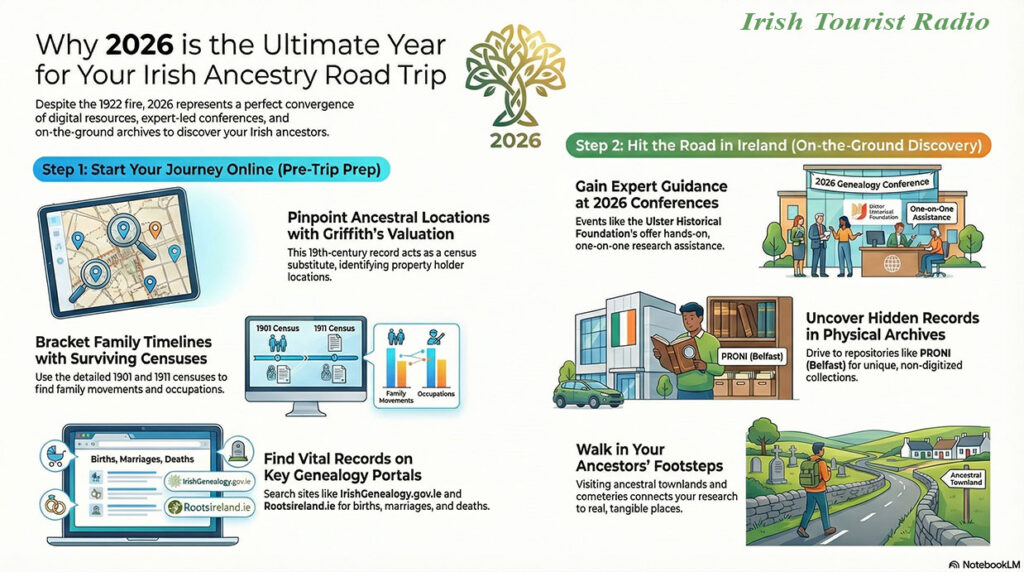
How does one trace the thread of a family story backward through time when the records themselves have gone up in smoke literally, in Ireland’s case, where the Four Courts fire of 1922 incinerated centuries of census data in a single catastrophic afternoon? The answer lies not in what was lost but in what survived, and 2026 presents an unusual alignment of resources, expertise, and accessibility that makes it the ideal moment to pack a rental car and navigate Ireland’s winding roads in search of ancestral ghosts.
Ireland’s 2026 convergence of technology, archives, and expert-led conferences offers unprecedented opportunity for discovering ancestors beyond the ashes of 1922.
The practical advantages begin with Griffith’s Valuation, completed between 1853 and 1868, which functions as a census substitute by documenting every property holder across the island. Available through platforms like AskAboutIreland and RootsIreland, these records provide not just names but geographic anchors—the precise townlands where great-great-grandparents paid rent, grew potatoes, or ran small shops.
Cross-referencing these with the surprisingly detailed 1901 and 1911 censuses (which miraculously survived) creates a bracket around family movements, occupations, and relationships that would otherwise remain opaque. For Catholic ancestors, who comprised approximately 90% of the population, parish registers become particularly crucial as they often predate civil registration and track baptisms, marriages, and burials across generations.
But digital records only carry you so far. The real advantage of 2026 lies in the confluence of specialized conferences and research programs designed to transform casual genealogists into competent archive navigators. The Ulster Historical Foundation‘s eight-day conference in Belfast combines structured lectures with hands-on archive work at PRONI, where collections extend far beyond Northern Ireland, including, somewhat counterintuitively, Dublin church records.
This matters because church registers serve as the primary source for births, marriages, and deaths before civil registration began, and PRONI’s holdings surprise many researchers who assume geographic limitations.
Similarly, the Roots Ireland conference scheduled for June 21-24 focuses specifically on uncovering ancestors through intensive research sessions rather than passive tourism. These events offer something no amount of YouTube tutorials can replicate: one-on-one guidance from professional researchers who know which yellowing ledgers contain gold and which represent dead ends.
The Ulster Foundation program includes visits to historic sites that add texture to bare facts standing in a churchyard where five generations lie buried, transforming genealogy from puzzle-solving into pilgrimage. The full conference package at £1,199 includes dedicated research assistance, all tours, three evening meals, six lunches, and entrance fees to attractions, representing exceptional value given the depth of expert access provided.
The road component shouldn’t be dismissed as mere logistics. Ireland’s county archives, local libraries, and historical societies hold collections unavailable online, and reaching them requires wheels. The North of Ireland Family History Society in Newtownabbey, Trinity College Dublin’s archival collections, and various county repositories scattered from Cork to Donegal demand itineraries that no tour bus accommodates.
Driving also permits detours to the actual townlands identified in Griffith’s Valuation, those strangely named places like Ballynahinch or Drumquin, where surnames cluster, and stories begin. This ancestral journey becomes even more profound when you include visits to megalithic structures that have witnessed the passing of countless generations since their creation 5,200 years ago.
Add emerging AI tools demonstrated in webinars like January’s session on document analysis, and 2026 becomes less a year than a convergence: technology meeting tradition, digital breadcrumbs leading to physical places, conferences providing skills immediately applicable in nearby archives.
The question isn’t whether to go, it’s how soon one can book the flight.
How to Trace Your Irish Roots by Road: Key Resources & Links
Whether you’re just beginning or deep into your family history research, the following essential online and in-person resources will help you prepare for an unforgettable Irish road-driven genealogical adventure in 2026. They blend digital access with real-world travel, exactly what you need to follow ancestral footsteps across Ireland’s counties.
Online Record Portals (Pre-Trip Research)
These sites are perfect starting points before you hit the road. They help you locate names, townlands, and records you’ll want to explore in person:
-
Irish Genealogy (Government Records) – Free access to civil births, marriages, deaths, and many church registers. Searchable online before you travel. Explore Irish Genealogy records gov.ie
-
AskAboutIreland – Griffith’s Valuation – A vital 19th-century census substitute showing who lived where. Search Griffith’s Valuation online askaboutireland.ie
-
RootsIreland.ie – Extensive databases created by local genealogy centres island-wide. Great for baptisms, marriages, burials, census substitutes, and gravestones. Start a search on RootsIreland.ie rootsireland.ie
-
National Archives of Ireland – Genealogy – Free access to surviving census fragments, Tithe Applotment Books, wills, and more. Browse the National Archives genealogy site genealogy.nationalarchives.ie
-
GENUKI – Ireland Genealogy Portal – Larger contextual portal linking to many family history sources and county-specific information. Visit GENUKI for Ireland resources Wikipedia
Archives & Libraries to Visit by Road
These are must-stop places where digitised and physical archive collections await and where 2026 events and services will especially benefit road-based researchers:
-
Public Record Office of Northern Ireland (PRONI), Belfast
One of Ireland’s richest genealogical archives with wills, private papers, valuation records, and more. Wikipedia
(Attend the Ulster Historical Foundation conference here for expert help alongside archive access.) -
National Library of Ireland (NLI), Dublin
Home to parish registers, directories, newspapers, and free family history services. National Library of Ireland -
County & City Archives Around Ireland
Many county libraries and local archives offer unique collections from old street directories to burial registers that aren’t online. For example:-
Dublin City Library & Archive – street directories, burial indexes, electoral registers. Dublin City Council
-
County archives and societies – Cork, Galway, Kerry, Donegal, etc. (note: many operate on appointment or walk-in bases)
-
Expert Help & Societies
Getting local guidance can make your trip far more effective:
-
Irish Family History Centre (EPIC, Dublin) – Book expert consultations to jump-start your research. Irish Family History Centre consultations & info Irish Family History Centre
-
Genealogical Society of Ireland (An Daonchartlann) – A community archive and research centre with practical help for visitors. Wikipedia
-
Local Historical Societies (e.g., North of Ireland Family History Society) – Often hold unique regional records and host talks/workshops you can attend during your road trip.
Road Trip Itinerary Ideas
Use your online research to plot a route based on:
1. Townlands where ancestors lived
Drive to Ballynahinch (County Down), Drumquin (County Tyrone), or Tuam (County Galway) to see the land and local churches mentioned in Griffith’s Valuation. ulsterhistoricalfoundation.com
2. Record repositories
Plan a day in Belfast (PRONI), followed by a few days in Dublin (NLI, Irish Family History Centre, city archives).
3. Local cemeteries & parish churches
Visiting graveyards and parish churches gives tangible context and often uncovers inscriptions or registers unavailable online.