
While Ireland’s tourism industry continues to generate nearly €9 billion for the national economy, cementing its status as the country’s largest indigenous industry, the Emerald Isle’s grip on international travelers has begun to slip in ways both subtle and unsettling.
July 2025 brought 646,400 foreign visitors to Irish shores, a mere 1% decline from the previous year that might seem negligible until you examine what lies beneath: tourists are spending less time (7.9 nights versus 8.1 the year prior), contributing fewer euros (€624 million, down 4%), and collectively delivering 10% fewer overnight stays than just two years ago.
The numbers tell a story of gradual erosion rather than catastrophic collapse, the kind that creeps up slowly, like rust on a gate you meant to paint last summer.
Yet there’s something oddly reassuring about tourism’s fundamental nature that distinguishes it from nearly every other economic sector. You cannot outsource a Cliffs of Moher sunset to a call center in Manila. The Guinness experience cannot be replicated via Zoom from a warehouse in Bangalore.
Tourism demands actual bodies in actual places, an economic anchor that cannot be digitized, relocated, or rendered obsolete by remote work.
Temple Bar’s craic is manufactured, though some of it may require actual human bodies occupying actual cobblestones in actual Dublin, spending actual money in pubs where actual bartenders pull actual pints. This geographical imprisonment of the product creates employment resilience that tech companies and manufacturing plants simply cannot match.
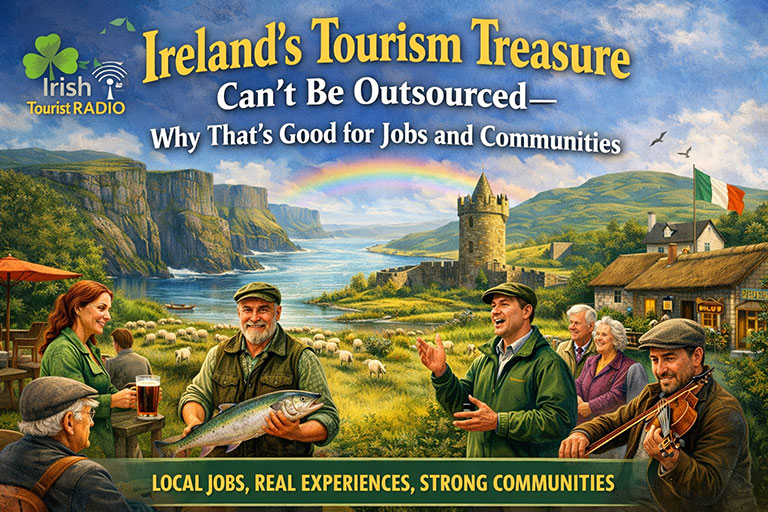
North American visitors understood this implicitly in July, accounting for €255 million, a commanding 41% of total spend, followed by Continental Europeans at €197 million. These travelers sought something irreproducible: the weight of ancient stone beneath their fingertips at Newgrange, the particular green of Kerry hills after rain (that specific chlorophyll-saturated shade that exists nowhere else), the rhythm of traditional music sessions in Galway where smartphones are tolerated but never quite welcomed.
They stayed in local B&Bs run by families who’ve occupied the same farmhouses for generations, ate in restaurants staffed by neighbors, and hired guides whose grandparents knew the same stories. Meanwhile, hotels accommodated 40.9% of all foreign visitors, with another third finding beds in the homes of Irish friends and relatives, a distribution pattern that spreads tourism revenue across both commercial operators and private households.
The Irish Tourism Industry Confederation hasn’t been subtle about tourism’s employment impact, positioning it as the nation’s biggest regional employer, a designation that matters profoundly in communities where factory closures and emigration have historically gutted populations. The sector’s economic footprint extends well beyond hospitality itself, with tourism affecting multiple industries, including transport, retail, and countless service providers whose livelihoods depend on visitor flows.
When 5.4 million visitors arrived over ten months ending in October 2025 (despite a 6.4% decline from the previous year), they distributed economic activity across peninsulas and villages that Amazon fulfillment centers will never reach. These visitors were drawn to megalithic wonders that highlight Ireland’s rich 5,200-year historical narrative, creating immersive experiences that simply cannot be digitized.
The challenge now involves reversing those downward trends without sacrificing what makes the product genuine. Because once you can outsource the experience, once it becomes replicable elsewhere or deliverable digitally, those jobs evaporate faster than morning mist over the Burren, and no amount of governmental hand-wringing can summon them back.
Reversing the Downward Trend in Irish Tourism
Reversing Ireland’s recent tourism slowdown does not require reinventing the product, but re-presenting it through smarter, experience-led innovation. Ireland’s competitive advantage lies in tourism that is rooted in place yet enhanced by modern tools: immersive storytelling apps at heritage sites, location-based audio guides narrated by local voices, and intelligent itinerary planning that links nearby towns, festivals, walking trails, and food experiences. This kind of innovation doesn’t replace the physical journey; it deepens it, giving visitors more reasons to stay longer, explore further, and spend locally.
A renewed focus on regional and year-round tourism is equally critical. Investment in slow tourism, rail-based travel, greenways, and shoulder-season festivals can draw visitors beyond traditional hotspots while easing pressure on Dublin during peak months. Community-led experiences from island stays and farm tourism to music schools and storytelling weekends keep tourism income circulating within local economies. When paired with targeted marketing to high-value markets such as North America and mainland Europe, these offerings reinforce Ireland’s global reputation as a destination best experienced unhurried.
Finally, innovation must support the people who sustain the industry. Helping small tourism businesses adopt better digital tools, improve yield rather than volume, and collaborate locally strengthens tourism’s role as Ireland’s largest regional employer. Encouraging domestic travel through staycation incentives and off-season promotions provides a stabilising base when international numbers fluctuate. Done right, these measures protect what makes Irish tourism uncopyable while future-proofing jobs and communities that depend on visitors being physically present here, in Ireland.