Ireland has a way of humbling even the most seasoned traveler, not through grandeur alone, but through the quiet, stubborn insistence of its landscapes that there is always something more to discover just beyond the well-worn path.
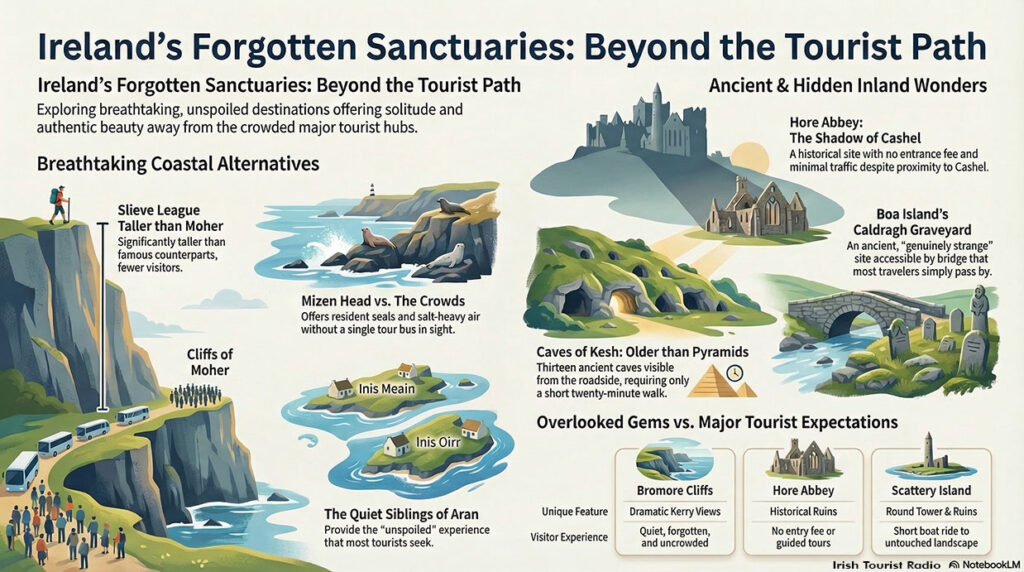
While thousands queue at the Cliffs of Moher, elbowing for the same photograph, places like Bromore Cliffs in County Kerry sit largely forgotten, offering equally dramatic coastal views to whoever bothers showing up. And almost nobody does.
Slieve League Cliffs are taller than Moher, a fact that seems almost accusatory, given how few people bother visiting them.
Mizen Head, Ireland’s southernmost point, compounds the irony further: comparable cliff views, resident seals, and the kind of salt-heavy air that rewires something in the chest, all without a single tour bus in sight.
Meanwhile, Galley Head in West Cork doesn’t even make most tourist lists, which is either a tragedy or a blessing depending on whether one values solitude.
The islands tell a similar story. The Aran Islands are famous, yes, but Inis Meain and Inis Oirr, the quieter siblings of Inis Mór, receive a fraction of the foot traffic despite representing what most visitors claim they came to Ireland to find: something unspoiled.
Scattery Island in the Shannon Estuary requires only a short boat ride from Kilrush and delivers a round tower, ruined churches, and sweeping views of a landscape that feels genuinely untouched.
Boa Island in County Fermanagh sits connected to the mainland by two bridges, yet its Caldragh Graveyard, overgrown, ancient, genuinely strange, goes unvisited by most who pass the signage pointing directly toward it.
History rewards the curious here in ways that feel almost unfair. Hore Abbey in County Tipperary offers genuine historical weight with almost no tourist traffic. Sitting in the shadow of the Rock of Cashel, it draws minimal crowds precisely because it charges no entrance fee and offers no guided tours.
Dun Aengus on Inis Mór presents an Iron Age fortress perched on a 300-foot cliff drop, with three walls between a visitor and an open Atlantic that doesn’t particularly care either way.
Leap Castle earns its reputation as Ireland’s most haunted, with legends dense enough to suggest the architects were specifically designing for dread.
Underground, County Fermanagh’s Marble Arch Caves stretch over eleven kilometers of discovered passages, three active rivers running through them like the landscape is still figuring itself out.
The Caves of Kesh in County Sligo, thirteen caves in total, older than the Pyramids, sit visible from the roadside, requiring only a twenty-minute walk that most drivers apparently decide isn’t worth attempting.
Ireland’s overlooked places don’t announce themselves. They sit patiently behind inadequate signage and minor detours, waiting for the traveler stubborn enough or lost enough to stumble through. After a day spent navigating forgotten roads, ducking into one of the country’s Irish village pubs rewards the effort with spontaneous music, a properly poured Guinness, and the kind of warmth that no itinerary can manufacture. For those willing to plan ahead, satellite view and Google Maps have proven surprisingly effective at surfacing these forgotten corners before ever setting foot on Irish soil.
The reward isn’t just scenery. It’s the particular satisfaction of discovering that the map was never really finished.