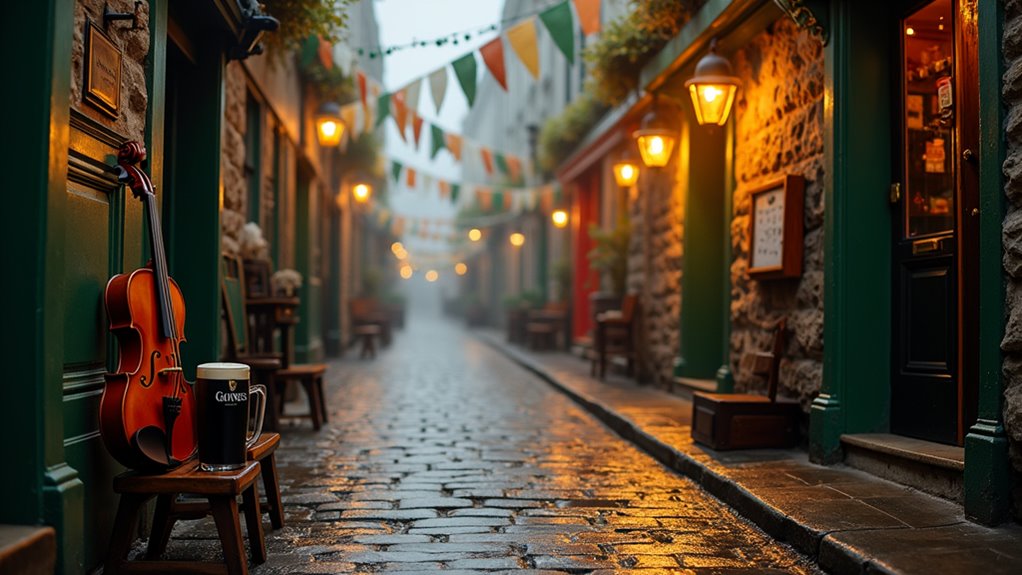

The rhythmic pulse of traditional music spilling from pub doorways, the lyrical cadence of both English and Irish languages mingling in street conversations, and the vibrant splash of festivals coloring ancient cobblestones—these elements form the unmistakable cultural heartbeat of Ireland.
While magnificent castles dot the landscape as stone sentinels of history, the true essence of Irish culture thrives in the living, breathing spaces between these monuments.
Dublin, with its UNESCO City of Literature status, pulses with stories that extend far beyond Trinity College’s ancient walls where the Book of Kells resides. In ordinary pubs like O’Donoghue’s, where spontaneous music sessions erupt nightly, strangers become friends over pints and shared choruses.
The city transforms each June for Bloomsday, when Joyce enthusiasts retrace Leopold Bloom’s fictional footsteps through very real streets—a peculiar celebration that would baffle most tourists but perfectly encapsulates Dublin‘s literary devotion.
While tourists stand confused, literary pilgrims wander Dublin’s streets, chasing the ghost of Leopold Bloom in annual homage to Joyce’s imagination.
Travel westward to Galway, and the cultural tempo shifts—not diminishes. Here, the Irish language isn’t a museum artifact but a living tongue, flowing naturally in conversations throughout the Gaeltacht regions.
The city explodes with creativity each July during the Galway International Arts Festival, while its Spanish Arch stands witness to centuries of cultural exchange that continues in different forms today. The annual festival has evolved into one of the largest multidisciplinary arts festivals in the world, attracting visitors from across the globe.
Cork’s contribution to Ireland’s cultural identity simmers in its renowned food scene and bubbles up through the operatic performances at Cork Opera House.
Meanwhile, medieval Kilkenny offers more than its impressive castle—it serves as a canvas for contemporary artistic expression against a backdrop of ancient streets.
Galway’s cultural significance is reinforced by its status as home to over half of Ireland’s entire Gaeltacht population, making it the true heartland of Irish linguistic heritage.
The Aran Islands—rocky outcrops in the Atlantic—preserve traditions not as performances for tourists but as daily practice.
Here, sweater-knitting patterns passed through generations tell family stories more effectively than any written history.
Ireland’s cultural heartbeat isn’t confined to tourist attractions or preserved solely in academic institutions.
It lives in ordinary moments: in céilís extending into early mornings, in bilingual road signs, and in the casual eloquence of stories shared across generations—proving culture isn’t something Ireland has, but something Ireland does.