A bureaucratic passenger cap imposed seventeen years ago on Dublin Airport a planning condition that once seemed as routine as stamped concrete and environmental assessments has erupted into a full-blown transatlantic aviation crisis, complete with diplomatic threats, allegations of treaty violations, and the very real possibility that U.S. carriers will slash their Irish routes rather than surrender the historic slots that have anchored their European networks for decades.
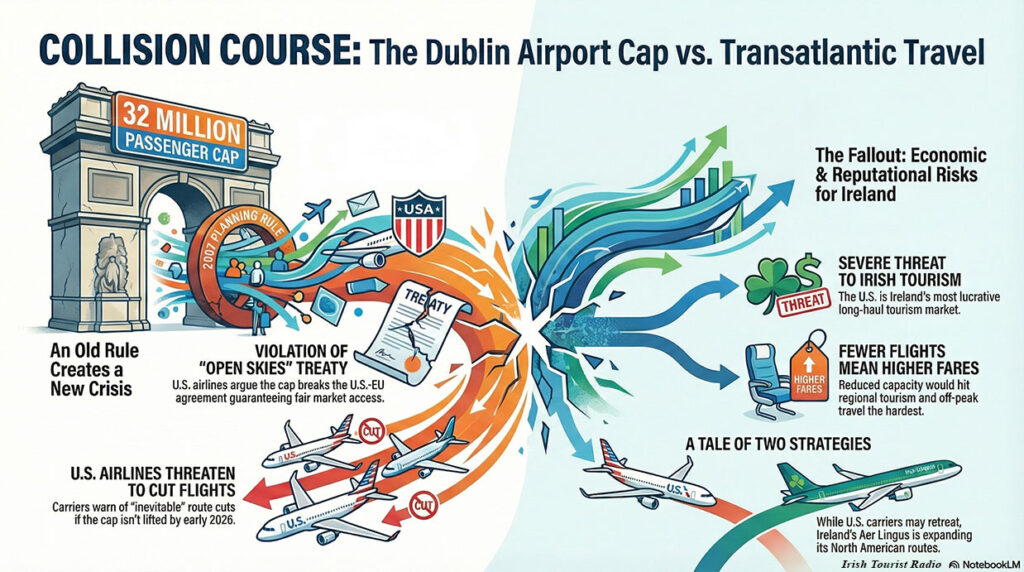
The 32 million annual passenger limit, tucked into the 2007 planning approval for Terminal 2, was hardly controversial when Dublin was processing far fewer travelers. But as post-pandemic traffic roared back and exceeded pre-pandemic levels, that ceiling transformed from administrative footnote to operational straitjacket. Airport management now views it as a stranglehold on network expansion, while the Irish Minister for Transport has pledged draft legislation to lift the cap permanently, allowing growth toward 40 million passengers and beyond.
From forgotten planning clause to existential threat: Dublin’s 32 million passenger ceiling now chokes the airport it once barely constrained.
Enter Airlines for America, the lobbying powerhouse representing American, Delta, United, and their peers. On January 7, 2026, A4A filed a formal petition with the U.S. Department of Transportation arguing that Dublin’s cap and any slot actions triggered by it violate the U.S.-EU Air Transport Agreement, better known as Open Skies. The complaint’s logic is straightforward: Open Skies guarantees liberalized access and non-discriminatory treatment, letting carriers operate routes based on market demand rather than artificial government-imposed limits. Enforcing the cap through slot withdrawals, A4A contends, would contravene both EU slot regulations and treaty commitments.
The stakes extend far beyond regulatory minutiae. A4A warns that, without a rapid resolution, U.S. carriers face the “inevitable” loss of historic slots at Dublin, the kind of grandfathered rights that have anchored their transatlantic schedules for years. Unlike European competitors who can juggle short-haul intra-European services to protect their long-haul positions, American carriers lack that operational flexibility. If forced to choose, they argue, the cap would “disproportionately and discriminately impact U.S. carriers,” potentially triggering cuts to entire Irish operations rather than marginal routes. The message is unambiguous: failure to lift the cap by early 2026 means fewer flights across the Atlantic.
The controversy has metastasized from local planning dispute into international aviation flashpoint. A4A’s filing references the specter of an “adverse CJEU decision” that could compel slot withdrawals, Dublin’s government might frame as legally mandated but which Washington would view as treaty-inconsistent. The lobbying effort seeks U.S. government intervention at both diplomatic and regulatory levels, pressuring Irish authorities to suspend or eliminate the cap before historic slots vanish and transatlantic frequencies evaporate. Meanwhile, Aer Lingus has announced plans to add twenty-six North American routes by summer 2026, leveraging four new Airbus A321XLR aircraft to expand its transatlantic footprint even as U.S. carriers face potential retrenchment. The airline recently launched budget-friendly fares from Dublin to Indianapolis at €249, further highlighting its commitment to transatlantic expansion. A recent High Court stay has provided temporary clarity for airlines operating at Dublin, though the underlying regulatory uncertainty persists.
What began as a noise abatement measure tied to a terminal expansion has become a test case for Open Skies enforcement, slot allocation principles, and the balance between local planning authority and international aviation commitments with Ireland’s transatlantic connectivity hanging in the balance, measured in withdrawn frequencies and canceled routes nobody saw coming seventeen years ago.
What This Means for Irish Flights and Irish Tourism
For Irish tourism, the implications are immediate and potentially severe. Transatlantic flights are not just aviation statistics; they are the arteries that carry millions of high-value visitors into Ireland every year. The United States remains Ireland’s most lucrative long-haul tourism market, with American visitors staying longer, spending more, and traveling year-round rather than seasonally. Any reduction in U.S.–Ireland flight capacity would ripple through hotels, car hire firms, regional attractions, golf resorts, and cultural festivals well beyond Dublin itself.
If U.S. airlines follow through on threats to reduce or exit Irish routes, the first casualties would likely be frequency and choice. Fewer daily flights mean higher fares, less flexibility, and a sharper drop in off-peak travel, precisely the kind of shoulder-season tourism Ireland has spent years trying to grow. Direct routes to secondary U.S. cities, which help spread visitors across the island rather than funneling them through Dublin alone, would be especially vulnerable. For regional tourism bodies from Donegal to Kerry, fewer Americans arriving through Dublin translates directly into fewer visitors venturing beyond the capital.
There is also a strategic risk to Ireland’s reputation as a transatlantic gateway. Dublin has spent two decades positioning itself as Europe’s most convenient North American entry point, aided by U.S. preclearance, competitive airfares, and a growing route map. A hard passenger cap, especially one enforced through slot withdrawals, undermines that positioning just as rival hubs in Amsterdam, Paris, and Madrid are aggressively courting transatlantic growth. Once airlines redeploy aircraft elsewhere, those routes are notoriously difficult to win back.
At the same time, the contrast between U.S. carriers potentially cutting back and Aer Lingus expanding raises complex questions for competition and capacity balance. While Aer Lingus’ growth is welcome for connectivity, a transatlantic market dominated by fewer operators risks higher fares and less resilience during disruptions. From a tourism perspective, diversity of airlines and routes matters as much as headline passenger numbers.
Ultimately, this dispute is not just about aviation law or planning permissions, it is about whether Ireland can sustain the air access that underpins its tourism economy. If the passenger cap is not resolved swiftly and permanently, the cost will not be measured only in lost flights, but in fewer visitors wandering Ireland’s towns, fewer Americans discovering the Wild Atlantic Way, and fewer seats filled at festivals, hotels, and heritage sites across the country. For a nation that sells itself on welcome and accessibility, the stakes could hardly be higher.