Ireland’s Tourism Tipping Point
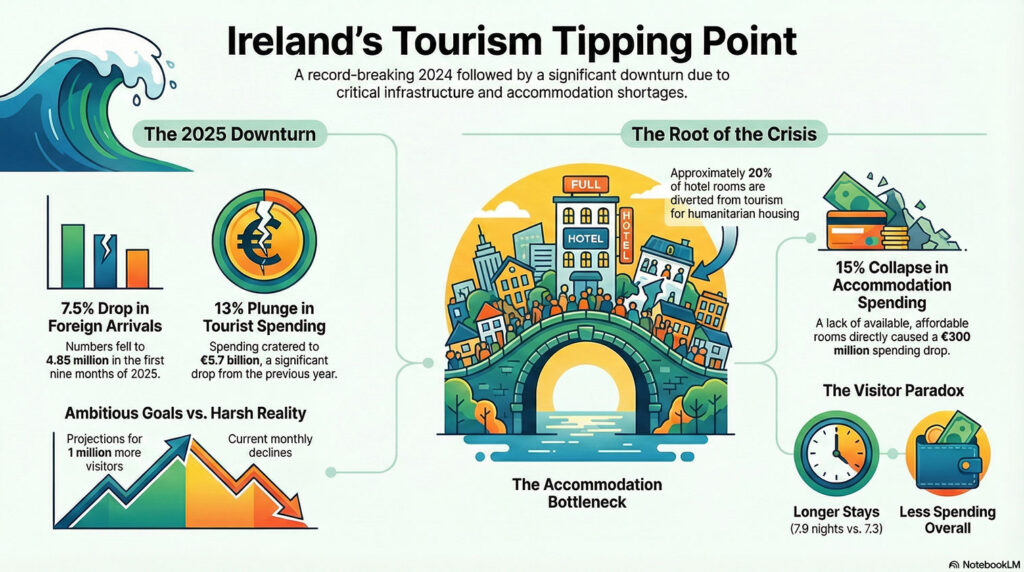
While Ireland’s tourism industry celebrated a triumphant return to pre-pandemic form in 2024, welcoming 11.3 million overseas visitors, just edging past 2019’s 11.2 million, the champagne corks had barely hit the floor before the hangover arrived. By the first nine months of 2025, foreign arrivals plummeted 7.5% to 4.85 million, and tourist spending cratered even harder, dropping 13% to €5.7 billion from the previous year’s €6.6 billion. The numbers tell a story Ireland’s tourism officials would prefer remained untold: we might have hit our ceiling.
Ireland’s 2024 tourism triumph turned sour by 2025: arrivals down 7.5%, spending cratered 13% we’ve hit our ceiling.
The projections seem almost comically optimistic now. Industry forecasters anticipated between 11.8 and 12 million visitors for 2025, one million more bodies threading through Temple Bar’s cobblestones, queuing for the Cliffs of Moher, jamming Dublin’s already strained infrastructure. Yet the math doesn’t math. With daily international arrivals averaging 31,000 tourists and visitor numbers declining month-over-month, that million-person increase looks less like ambition and more like delusion.
The real villain in this narrative isn’t the demand, it’s the supply. Specifically, beds. Ireland’s accommodation crisis has transformed from inconvenience into an existential threat, with roughly 20% of hotel rooms diverted to humanitarian housing. When 654,500 visitors arrived in June 2025 (down 2% from June 2024), they discovered a country stretched thinner than rashers on a breakfast plate. This situation mirrors the global visitor decline of 30% that has triggered economic shockwaves across tourism-dependent regions worldwide.
Accommodation spending collapsed 15%, dropping from €2 billion to €1.7 billion in early 2025, not because visitors suddenly embraced frugality but because there simply weren’t enough rooms available at palatable prices. With 45.3% choosing hotels as their primary accommodation type in June 2025, the pressure on Ireland’s traditional lodging infrastructure has never been more acute.
The irony cuts deep: visitors are staying longer, 7.9 nights in June 2025 versus 7.3 nights the previous year, yet spending less. They’re seeing more of Ireland while contributing less to its economy, a mathematical paradox explained by constrained supply pushing prices beyond tolerance. Meanwhile, cost-of-living pressures have driven Irish residents north to Northern Ireland, where £512 million was spent on 2.3 million overnight trips in early 2025, perceived as superior value.
Dublin, perpetually the tourism hub with 6.6 million visitors in 2019, bears the heaviest burden. The city that once charmed with Georgian doors and literary pubs now groans under the weight of its own popularity, its 330,000 tourism-supported jobs (2019 figures) dependent on an infrastructure that hasn’t scaled proportionally. The broader national picture shows tourism supporting ~260,000 jobs across the country, making the sector’s health critical to employment stability.
The question isn’t whether Ireland wants one million more visitors—tourism revenue projections of US$3.11 billion growing at 6.42% annually suggest we desperately need them. The question is whether we’ve built the infrastructure to welcome them without crushing what made Ireland desirable initially: the warmth, the accessibility, the feeling that you’ve discovered somewhere special rather than arrived at an overcrowded theme park.
Right now, the evidence suggests we haven’t. And projections notwithstanding, reality has already voted.
Policy Recommendations